Jens D over at the
Disoriented Ranger has been asking me about my Arthurian campaign that I never really ran but did a lot of work preparing. This is mostly because Jens is working on his 'Lost Songs of the Nibelungs' project, and his AD550 setting is conceptually pretty similar to my AD500 setting... his is focussed more on Germanic Europe (though not exclusively) and mine was focussed more on the ex-provinces of the Western Empire (particularly Britain, but extending into other areas, both in and without the Empire); but neither of these settings is considered to be exclusive an anyway, they're only 50 years and a few hundred miles apart - practically identical in gaming terms, no?
So what is there to say about my Arthurian setting that I haven't said already?
Well, first it's so old-school it barely exists electronically at all. I 'wrote' it - what I wrote at all, and didn't just imagine - using a curious system called 'pencil and paper'. I have some things, written and overwritten and scribbled out and recopied and changed on other bits of paper. That's going to make it difficult to actually stick up here.
Secondly, I never really ran it as such. It was just a structure to hold things together. The players would be operating in this world with big plots going on around them that they could interact with but the basic nitty-gritty of being murder-hobos would be... well, pretty much the same as most other D&D games. They'd still be going round taking rewards from villagers who needed saving from the Orcs who'd taken up residence in the caves north of town, or tracking down rumours as to where the Wizard Valerian had his tower so they could loot it. That sort of stuff. Only, conceptually, the Tower of Valerian might be an old Roman watch-tower, and the silver coins that the party got as a reward for killing the Orcs would be sesterces.
I started with a bunch of assumptions. Some were about the 'story' aspects and some were about gaming, how the rules would work. The two aren't separate of course, but teasing out the different aspects is probably easier if one assumes that they were. So I'm going to to describe the assumptions about the game-world first, and then specific rule-tweaks or interpretations that flow from that.
Firstly, that the earliest legendary or pseudo-historical sources for 'King Arthur' and the history of Britain were more-or-less accurate. So, in this conception, Arthur was a warleader who fought against both 'Saxons' and other British leaders, fighting a series of battles in various parts of Britain. These battles are numbered; these numbers would provide an approximate framework for the passage of 'campaign time' over several years (it became 9 years in the end). The locations would also pattern the geographical space of the campaign as well as the time. I fixed the locations and used these as the regions of Britain that the adventurers would be adventuring in. The assumption would be that the results of the PCs adventures would somehow affect the overall structure of the story in the campaign-world. For example, if the PCs were successful in disrupting the humanoids' plans in 'The Keep on the Borderlands' (in this instance, relocated to the East Midlands of England, near Peterborough if I recall correctly) then this would mean that at the subsequent 'Arthurian' battle in space & time (at the ford of the river Dubglas in Linnius, which I took as being in Lincolnshire), the humanoid enemies would not be able to send their full contingent to the battle. Of course, if the PCs failed to significantly disrupt the humanoids'/evil priests' plans, then the humanoids would march off to battle undisturbed, making the eventual victory of Arthur's forces less likely. In this way, the PCs would be acting as commandos or partisans, disrupting the enemy's supply lines and infrastructure, in order to make it more difficult for the forces of chaos to wage war.
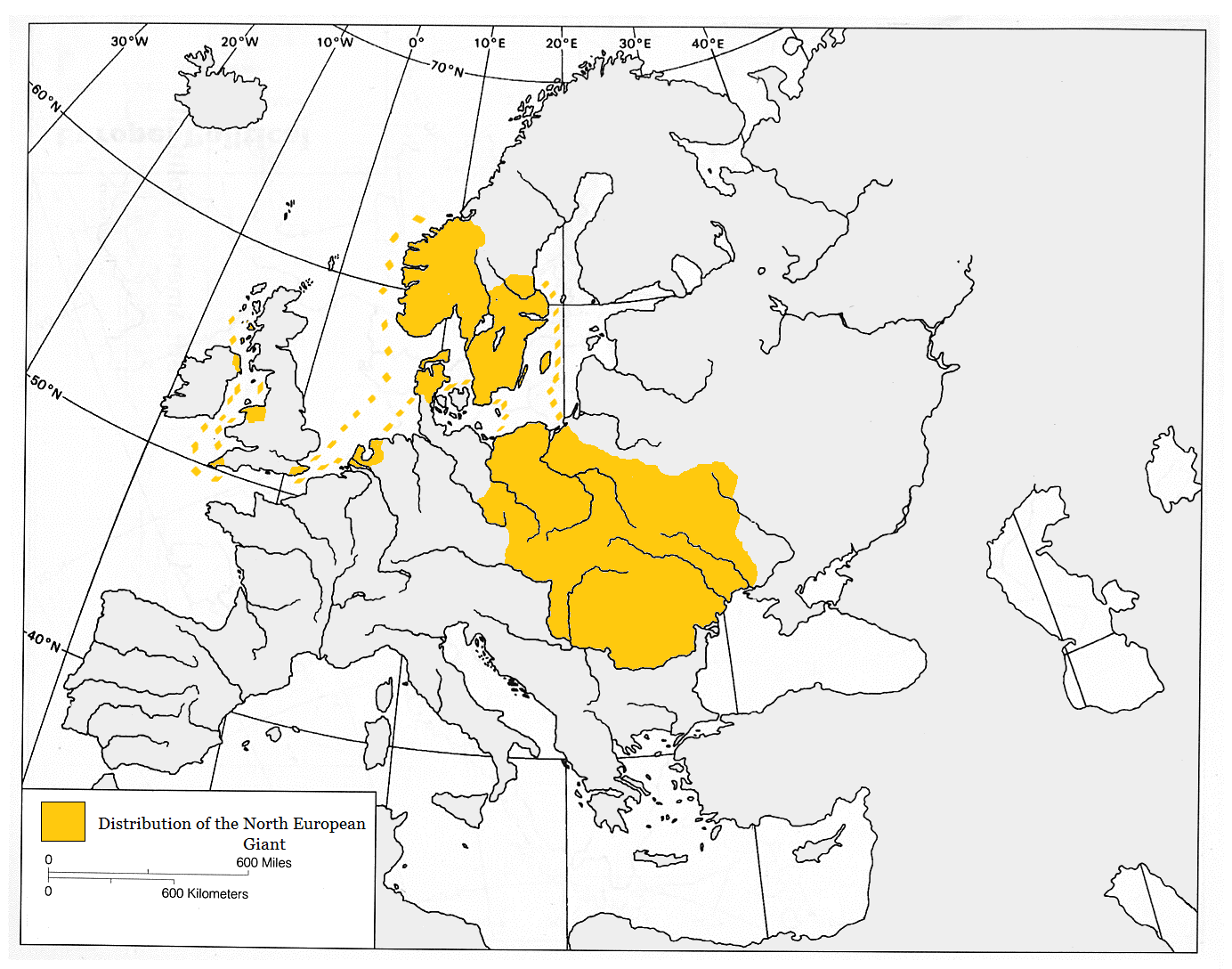
For reasons already explained elsewhere, I identified the Angles with Orcs, and played many of the invasions of the lands of the Empire, and sometimes the races inhabiting it, as being by 'monsters' or demi-humans - apart from Angles = Orcs (also, Orkney ie the Orcades would be Orc-islands - it was much later and mainly for a joke that I decided that most of Northern Englland should be 'Orkshire'), Goths/Jutes = 'Giant races', Franks = werewolves, Irish (Gaels) = Ghouls, Greeks (Hellenes) = Elves and the Langobardi (Longbeards, Lombards) = Dwarves. Later I decided to assimilate the Burgundians to the Nebelungs and make them Dwarves too, and the Danes (and any other Dan- or Tan- names) Elves of the 'Tuatha De Danaan'. Mostly I was assuming that things would be set in Europe but I was also working on other areas being visited - in which case Uruk in Mesopotamia would be an Orc-city, the former kingdom of Elam would be a land of Elves and Judea, much like the land of the Eoten in Scandinavia, an abode of Giants. This is what is currently what is feeding into the idea behind the 'Observer's Book of Monsters' - monsters have particular distributions based on their legendary distributions.
Second, I assumed that some of the really fantastical sources had some validity in terms of quests and whatnot; the Quest for the Holy Grail, which in some ways is a retelling of a story about sailing (possibly to Ireland?) to find a magic cauldron (itself a theme of other Celtic legends) can be part of the overarching plot too. So, I knew I wanted a plot about a quest for a cauldron. Swords, too - the Sword in the Stone and Excalibur (AKA Caliburn or Caladvwlch), the finding and getting and losing of which play an important part in the stories of Arthur would be important. Celtic legends mention swords as well as cauldrons. In fact there is a quartet of treasures from Irish legend made up of a sword, cauldron, spear and stone. These are the four treasures that appear in
Alan Garner's Elidor; and I wanted to take the idea from
Elidor and such works as
Song of the Dwarves (by
Thorarinn Gunnarson, who it seems also wrote some Mystara-based fiction) the idea of linked adventuring worlds too.
The Four Treasures - two of which had become the direct objects of mythic quests already - would each be linked to an element in the classical system of elements (Earth, Air, Fire and Water). Each element would also be linked to a race. This goes back to a very early stratum of my campaign-design, the first campaign notes I ever wrote in about 1981. Back then, I assigned the elements on the following basis: Dwarves - Fire; Elves - Air; Halflings - Earth; Humans - Water. This time, I assigned them as Dwarves - Earth; Elves - Air; Humans - Water; Orcs - Fire. The four races in turn would each be properly linked to a home-world that the players would journey to. This world-element-treasure-race linking would then determine the character of that homeworld/adventure zone.
So, I had four linked worlds, each with its own special treasure, each the home-world of a particular race, and some idea that the point was that the players adventure through these worlds as part of their mystical questing. The overarching quest-thing (following the years of fighting in Britain with odd side quests) would be a sort of restoration - the idea would be to get rid of a treasure that didn't belong, and restore it to its rightful world. The first of these quests would be to take Arthur's air-sword (by a process of assimilation this I considered to be the Sword of Nuada Argetlam, AKA Nodens, AKA Ludd Ereint Llaw, formerly worshipped at Lydney in Gloustershire) to where it belonged - the next world along, which would be the world of Air/Elves.
This was going to be the world of Warhammer. Yes, each world would have its own rule-set. The world of the Elves would be governed by the rules of WHFRP, and completing quests there would lead to the next world; the world of Orcs. This would be accessed from Warhammer World by finding the Fire-Spear, would be governed by a mish-mash of the Runequest and Stormbringer rules, and would feature a geography that was substantially the Young Kingdoms with as much of Glorantha as I knew about mushed into it, up in the north-east corner. Restoring the Fire-spear to the Kingdom of Org (a realm of degenerate ab-humans in the Young Kingdoms, located in the Forest of Troos, which with the addition of Trolls from the Runequest setting became an ancient Orkish kingdom in my conception), the next bit of the journey through the worlds would see the PCs finding the Earth-stone and taking it to the next world, that of the Dwarves, where they would find that they were in Middle-Earth.
Now, I know the Tolkien's Middle-Earth is also
our Middle-Earth. But then, the world of the Young Kingdoms is also our Earth, as Elric proves when he summons the soul of Roland. It doesn't matter. In this campaign, they're all linked parallel worlds. Anyway, in Middle-Earth, the PCs would restore the Stone (of Destiny) to the Dwarves, and then find the final treasure, the Cauldron that they were after all along, and return to our world with it, thus restoring the cosmic balance and all that jazz.
That then was the overarching conceit of it all. Pretty much every bit of D&D stuff I owned, as well as all the Warhammer, MERP and RQ/Stormbringer stuff I had, was going to be shoe-horned in somehow. There would be about 9 years of battles and adventuring in our world - which I more or less assume would mean that in the first year, they'd be First Level, and in the ninth year, they'd be Ninth Level - and then instead of settling down to build a lordship and a dynasty, I thought I'd send them on a weird dimension-spanning quest. In each world they visited, they'd have to translate that character into a functional equivalent in the new system. It never reached that point, but I'd have been perfectly OK with them leaving that character in that campaign world and bringing another character along to the next world, should they decide to do that (or you know, if someone
died).
As for assumptions about rules, the most important was that -
as I outlined in a post the other day - what was in the books was assumed to map onto reality as it was perceived by the people involved. Armour, for instance. I assumed that 'plate mail' in the rules meant 'the best armour you could get'. Therefore, the best armour in the late C5th arguably being old Roman armour, I reasoned that this must be functionally equivalent to plate. Everyone wearing 'plate mail' in the sources I had must logically have been wearing lorica segmentata, as there was no such thing as 'plate mail' in AD495. I did wonder about cross-bows - as far as I knew at the time (pre-internet days!), though the Romans had ballistae, they didn't have personal hand-held cross-bows. But for the most part, I used the weapon- and armour-lists as written.
One major change that I decided on was to scrap the Experience rules. Character advancement is painfully slow in OD&D, as
John Arendt points out in this very cromulent post from Dreams in the Lich House. If it takes a First Level Fighter the same amount of combat as embodied in 200 Orcs to reach Second Level, whereas in modern games it takes the combat necessary to defeat 3 Orcs, this explains two things: why my current party spends so much time complaining that they're never going to reach Second Level and if this were Skyrim they'd all be 3rd Level by now (they've defeated 3 Fire Beetles, 3 Robber Flies, 1 Giant Centipede, 4 Acolytes and a L3 Cleric), and also, why I never managed as a player to take a character past 3rd Level. My revised conception (as these events were all going to take a long time, ie several years) would be that each year would constitute a Level. The first year of the campaign would be AD487; this would be the year of a lot of First Level adventuring round the East Midlands and the Battle of the River Glein (the Lincolnshire Glen); the second year of the campaign and Second Level aventuring would also mostly happen in the East Midlands, culminating in the battles of the River Dubglas in Linnuis (also Lincolnshire - I don't want to get into arguments about 'actual' sites, I picked some that made some sense to me). Eventually, after 9 years of adventuring, the last battle would be Badon Hill in AD495. Jens D is currently examining some other aspects of the question of time over at Disorientated Ranger
in this post.
Otherwise, everything was pretty much as written, I didn't have to change very much. I wasn't overly concerned about the vast amount of gold in D&D for example, I really don't care if the economy is inflationary, though at various times I've tinkered with reforming the coinage. But it isn't all that important in the scheme of things.