Showing posts with label D&D. Show all posts

Wednesday, 22 April 2026

Starting a new campaign... as a player!

I've been invited to join a new campaign that's starting up. The DM and at least one of the other players are long-known to me, having been part of the Rift City campaign going back before Covid (and we've known each other for decades, it just took a long time to getting round to playing D&D together). I'm pretty sure I also played some 5e with one of the other players, under the DM that is running this campaign, but again, that was pre-Covid I think (a good few years ago now, anyway).

It's a 5.5e campaign, which is a new thing for me, but it seems pretty similar to 5e from what I remember (I first played 5e back in about 2016 I think, and then as I say maybe about 2018-19). It's all very complicated.

The setting is 'Wuxia'. I'm trying to get a handle on the world we're in, which mentally I'm pitching as being somewhere on a continuum from 'Kung Fu Panda' to 'Crouching Tiger, Hidden Dragon'. I originally conceptualised this as 'Monkey' to 'Crouching Tiger, Hidden Dragon', then realised 'Monkey' is where I hope we end up, and you could instead run the line from 'no humans, everyone's flying about doing kung fu' to 'all humans, only a few people are flying about doing kung fu' (there is, beyond this point, 'The Water Margin', in which, as far as I remember, there are all humans, but no-one is flying about doing kung fu). 

Monkey - the original and best. Sandy, Monkey, Tripitaka, the horse (who is also a character in 'The Journey to the West'), Pigsy. Yes, I know it's a Japanese interpretation of a Chinese story about people going to India, but I don't particularly care, it's still awesome.


And then there's this one - the Monkey remake from 2019. Sandy, Monkey, Tripitaka, Pigsy. Yes, I know it's a New Zealand remake of a Japanese version of a Chinese story about people going to India. I thought it was not too bad - I liked the baddie (not pictured in this picture).

I figured I'd quite like to play a Monk. It's a bit of a classic of the genre. Obviously, apart from 'Monkey', there's a lot of things I can take as inspiration - 'Kung Fu', 'Bulletproof Monk', 'Dr Strange', 'House of Flying Daggers' and 'Hero' for a start that I can think of, I think I may watch some of them again (I have a few at least on DVD).

I'm playing about with an idea that I could play a 'shan xiao' - a 'Mountain Imp' (or perhaps 'Mountain Demon'). I came across them looking at this site to get information on Chinese folkloric monsters.

Mountain Imps and Household Goblins

In Chinese folklore, mountain imps known as shan xiao (山魈) are depicted as petty, misshapen demons inhabiting remote wild areas, often functioning as malefic tricksters that embody the dangers of uncivilized frontiers. These entities, likened to European goblins or Russian leshii, are bizarre creatures associated with affliction and mischief, such as leading travelers astray or pilfering tools in forested mountains. Regional tales from Sichuan portray them as dwarfish, horned figures capable of both guiding lost wanderers to safety and engaging in deceptive bargains for luck or protection, though betrayal of such pacts invites curses and misfortune....

Regional Variations Across China

In northern China, particularly in regions bordering Mongolia such as Inner Mongolia and the northern provinces of Shanxi and Shaanxi, folklore features hardy mountain goblins known as shanxiao, depicted as mischievous spirits inhabiting remote peaks and steppes. These entities often embody the harsh environment, with tales where goblins serve as tricksters guarding landscapes, blending Han Chinese beliefs with steppe animism. For instance, shanxiao are described as beings that lure travelers into peril, reflecting the nomadic hardships and vast terrains of the north, distinct from more urban Han variants.

I definitely wanted my shan xiao to be Northern - just my prejudice. Both Northern and Southern shan xiao lure travellers from their path (or potentially put them back on it), so that's fine, I can go with that. A great description is 'malefic tricksters'; and a Goblin seemed a good choice for how to do that. Maybe a Kobold. But, neither Goblins nor Kobolds are playable races in 5.5e. They are described as 'petty' (which I took to mean 'small' rather than 'pointlessly argumentative and prone to grudges'), and the Southern varieties of shan xiao at least are 'dwarfish' (I assume meaning 'small compared to humans', and not 'bearded with winged helmets, beating metal and singing about gold'). That to me ruled out playing an Orc, because Orcs aren't generally considered smaller than humans in D&D, and I definitely wanted to go with something tricksy rather than brutish. I did consider playing a Gnome, but I find it hard to separate them from Western cultural tropes. But the Southern shan xiao are described as being horned, and that - along with their tricksy, perhaps demonic, nature - made me think of Tieflings.

Obviously, not being much of a late-editions player, I don't know very much about Tieflings (perhaps liberating me from the baggage I might otherwise have brought). From what I can gather, they're sort of Half-Demons in the same way that Half-Orcs are Half-Orcs and Half-Elves are Half-Elves. Of course, they've done away with Half-Orcs and Half-Elves in 5.5e. But they haven't done away with Half-Demons.

That's where I'm at currently - a Tiefling Monk. I put a bit of work into that and I'm fairly happy with how it's going. Character creation is a bit weird, though, I'm rather more used to rolling some dice and saying 'so what does that get me?' rather than going 'what do I want and how can I do that? Oh, and what do all these choices mean?' but I'm sure I'll get my head round it eventually. Not knowing what the end result is does make some of the choices seem a bit arbitrary though. 

I did make one roll (electronically, I couldn't be bothered to look for my dice, but have since remembered they're in a bag, inside another bag, approximately 4 feet from where I'm sitting). There is a d% roll you make to find a 'Trinket' during character creation, and I rolled 90. My 'Trinket' is a single ancient arrow of Elven manufacture.

That left me wondering. Not sure if there are any Elves in this setting, they're perhaps (qua Elves, anyway) a bit Western, but, I'm going to assume for the time being that there are some aethereal tree-spirits that might use bows somewhere in the realm. Whether they might sing a lot is currently unknown.

Anyway, that aside, that's what I ran with. We've been told that we're starting 5th Level. Cool, I get to pick a Monkish school for him to be involved with. I chose Way of the Shadow-Warrior as it seemed to go with my conception of his as being tricksy and somewhat sinister. Meet Shan-Linghun, Tiefling Monk of the Shadows, rendered in mini-form (or at least, illustration thereof) via the Hero Forge interface (here, in case anyone on the planet doesn't know what Hero Forge is).


Tiefling Monk with lots of gear, courtesy of Hero Forge

He's got a lot of kit. Given his Monk class he gets a spear and five daggers, as well as either a musical instrument or a tool-kit. I gave him the 'Guide' background (leading travellers astray, or to the right path) which gives him a Cartographer's Kit (so he had one toolkit anyway), so I went with a musical instrument as my Monk option. There's something Pan-like about him, so I thought maybe he could play songs in the misty hills, luring travellers with his haunting flutey melodies. Guides also get a shortbow and 20 arrows as part of their starting equipment. 

This, confusingly, is a weapon with which he has proficiency, but is not counted as a 'Monk Weapon'. As far as I can tell, this means that he's got a bonus to hit with the shortbow, but he can't utilise special Monkish skills like multiple strikes or using his ki-power. These have to be used with melee attacks. No matter, as I see it at the moment he can use the bow at some distance and if things get up-close and personal he can drop his bow and start leaping about and punching people, or using the spear and daggers I guess - he isn't an 'Open Hand' Monk, he's a 'Shadow' Monk, which means he's more of a sneaky, stealthy type, but I shall have to look into what that means exactly, all of this is new to me.

Anyroadup, that's where I'm at. Expect intermitant updates on this...

Friday, 20 March 2026

Not Building a Chapel

A while back (link here), I had an idea for trying to build some of the buildings in the Keep on the Borderlands. I started - at least, as far as trying to do a mock-up of one of the buildings. My idea was to start with the Chapel (building 17 on the Keep floorplan). This, I was certain, was a good start. I thought I could use it as a free-standing chapel or temple building if I needed such a thing for gaming. A chapel is always useful, right? My plan was to do it in a style that would more-or-less fit medieval Europe, a Warhammer-y fantasy early-modern Europe analogue, could be in Middle-earth with a bit of squinty side-eye, would serve as an old chapel in more modern Victorian sci-fi-ish gaming, or could even be a non-ruined building in the 41st Millennium, if they have non-ruined buildings. A generic stone hall-type building of vaguely religious bent - that could cover a lot of genres of gaming. Re-using anything to do with wargaming always seems like a good idea to me (I don't have infinite space or money, so anything has to be potentially able to serve a variety of functions), so, enthused with the idea that it would fit with almost anything I was likely to do, I embarked on the planning process.

It was not a good start. 

I'm going to quote from the description of the Chapel in the module:

"This building has a peaked roof two stories tall; the interior is one large room. The altar is located at the eastern end, with a colored glass window (worth 350 g.p. intact) above it; the window is 20’ tall and 8’ wide."

This was all fairly understandable, I thought. Looking at the map, the Chapel is 60' long and 20' wide, with doors at the west end. So far so good.

Excerpt from the plan of the Keep in The Keep on the Borderlands (c) TSR/Wizards of the Coast

I got into a bit of a flap about what a 'peaked roof two stories tall' meant however. Did it mean the roof was two storeys tall, atop a building of unknown height? Did it mean the building was two storeys tall including the roof? These speculations came back to haunt me later, but I'm getting ahead of myself. I'm pretty certain it was intended to mean, 'a peaked roof that makes the building two storeys tall at its peak' (the quotes obviously are in American English but I'm British, a 'story' to me is a told narrative, the floor of a building is a 'storey'). On this interpretation, I just need to know what 'two storeys' means. I decided that to keep things simple I would treat each storey as 10' (though I did flirt for a while with 12' - see below for 1:72 v 1:60).

This gave me the basic (in-game) dimensions of the building - 60' by 20' by 'two storeys' = 20'.

But what does this look like in practice?

I have generally applied a 1:72 or sometimes1:75 scale to my gaming involving miniatures. Both D&D and Warhammer use Imperial measurement, so I assumed that 1"=6' (one inch = 6 feet/72 inches). This after all was the scale of minis back in the day - if 25mm = 1" (it doesn't but close enough) then a 1" or 25mm mini represents a 6' (72") person. All well and good, that's 1:72. Later I decided that 4mm might equal 1', but as I never got round to building anything related to that scale it didn't matter. My D&D playing never really got to the 3rd Ed+ 'battlemat'-style of play (maybe that was 4th Ed, I don't really know) so I didn't do the 5' square thing that became very popular. I'm an old-school-10'-blue-squares-kinda guy.

So, how to convert 10' squares into terrain? It never bothered me before, I just made what I had and hoped it would kind-of fit. But now I was making a model to a pre-existing plan, based mostly on 10' squares, and occasional descriptions to fill in details.

I spent a lot of time going backwards and forwards between 1"=6' and 1"=5'. I should not have bothered. The sheer faff of trying to 5/6 or 6/5 everything was a baffling ordeal. I decided in the course of the planning for this build that from now on, 1:72 be damned, 1:60 is the way to go. 1"=5' and that's an end to it. I think this is the scale of the D&D battlemats so that's good... though the Keep in plan is 365' north-south - if I ever get the whole thing built, that will be 73", which is an inch over 6 feet; at 1:72 it would 'only' be a shade under 62", or 5-foot-2. But even though it increases the size by 6/5, it's so much easier to work with 1'=5" so that's what I decided would be the scale. And will be for all future builds I do that concern minis (and why would they not concern minis?).

So I decided on a scale, and started with a model-of-my-model. I have some foamcore - I bought it quite recently for building models, but have not used it yet, so thought I would use it for this build. But before I started hacking up my foamcore I thought I would plan out the build in cardboard just to see if it looked right. I can get cereal-box card out of the recycling, so I decided rather than jump straight in with the somewhat expensive foamcore (more expensive than 'free', anyway) I might as well build a test model to make sure I was happy.

So, I went back to the description. OK, questions about the exact meaning of 'two storeys' aside... peaked roof... well, that's pretty clear isn't it? It's not a flat roof; the roof is not a single slope from a higher wall to a lower; it's not a barrel-vault. Fine. I can work with a peaked roof (probably easier than working out how to do a vaulted roof). It doesn't say if it's a moderately-steeply-peaked roof, as in a more 'Gothic' style of architecture, or if it's a shallower angle of roof, a more 'Romanesque' style that you might find in Ravenna, let's say (which, though not so well represented on game-boards, is something of the model for Gondor, for example, both in Tolkien's imagination, and in terms of the visual language of Jackson's films). So I thought I would explore both. These are two of the potential designs I came up with for the west (entrance) end, based on 'two storeys' being 20' (bear in mind I've now gone from 1 square = 10', as in the plan, to 1 square = 5' = 1", for modelling purposes).

'Gothic' and 'Romanesque' (Classical?) west elevations

But the description also mentions a stained glass window, 20' tall in the east end. But the whole building is only 20' tall (ie, two stories) isn't it? Maybe I'm getting my storeys wrong. 2&1/2 inches? 3 inches? This moves my 10' storeys to 12'6" or even 15'.

I can't change the storeys that much. That would make everything far too tall, I think. Maybe I could make the walls of the building two storeys, with the roof on top of that? So I started playing about with elevations for the east end. There's no indication that there's any kind of internal differentiation; in fact, in the description it says 'the interior is one large room' - no mention of subdivisions or towers or anything. So my assumption is, the east and west elevations must match. Therefore, I need to find an elevation that works at the east end, with the window, then take out the window and add the doors for the west end. Simple. These are two of the elevations I came up with (there was a third intermediate form with a 45° pitch) - now abandoning any idea that 'two storeys' meant the total - it had to be the hight of the building without the roof... maybe... because I couldn't see how the stained-glass window could start at ground-level, it had to be raised somewhat, surely?

Potential east elevations

So, this is where I got to with the elevations. I took the (perhaps arbitrary) decision that the window would start 10' up the wall. Suddenly the building was not 20' tall, but 35' tall, in order to accommodate a 20' tall, 8' wide window. And, the Romanesque version at least looked like it would be 30' to the top of the wall - that was starting to look like three storeys, and that without the roof.

But it got worse. Consulting the plan again I realised that the Chapel butts up against another building at its east end - the end with the window. Checking against the description of location 4 - the Stables, which are the building immediately to the east - one finds this information:

"4. COMMON STABLE: This long building is about 15’ high, with a 3’ parapet* atop its flat roof, so that it can be used in defense of the gate. The gateside wall is pierced for archery..."

So the parapet (leaving aside the notion that it's only 3' high for now, that can't mean what it appears to mean) is used for defence, and is on the opposite side from the Chapel. But the whole building is still 15' high and has a flat roof. The side that is adjacent to the Chapel is 15' high.

Now there is no possibility that the window starts below the level of the building immediately to the east of it, that is absurd - unless the window predates the stables, and the latter was constructed against the wishes of the Chapel authorities... I could go with that but it seems pretty far-fetched, and I don't want to waste time explaining that the building 'mistake' isn't my mistake, it's part of the history of the castle. So the window must be at least 15' above ground level, and add a further 20' on top of that, and it can't go right the way to the roof, there must be some clearance at the top... and that would put the bottom of the window on the same level as soldiers fighting on the roof of the stable, risking them toppling into the window if they were injured up there...

The simplest solution to the whole problem is to assume that the building itself was 'two storeys' - that is 20' - and the roof was on top of that, and also, that the height of the widow was included in the roof and not the height of the building (ie, the bottom of the window was also at 20').

So I came up with the following elevation...

West elevation with 'tall' roof

Gone was any notion I could do a 'Romanesque' version of this. I could just about sneak a 'Gothic' arched window under a steeply-pointed roof; the possibility to do the same with a rounded window on a roof with a shallow pitch would have meant walls 40' (four storeys, not two) high.

So this is what I went with - a 45' high, 20' wide, 60' long Chapel, with the window taking up almost the entire height of the roof, starting 20' above ground-level. It was the only way I could see to get all the pieces to fit.

And it looked rubbish.

The whole thing was a daft, spindly thing that was far too tall (and long) for its width. I hated it.

I can only assume that Gary Gygax never build cardboard models of all of this (or maybe he did and he thought it looked OK - which is fine, we all have different appreciations of aesthetics). Either way... this was a success, in that I didn't waste the foamcore (it's still in the loft in its pristine state, and I'm still playing with cardboard), but also, a failure in that I didn't get a model chapel either for my 'Keep' gameboard or for anything else.

So I shelved the plans until I came up with a solution.

My favoured solution at the moment is, there is no stained-glass window. Maybe I will revisit this sometime and see what other solutions I can come up with but if - and it's a big 'if', now - if I build the Chapel, I will probably do it without the window. It's the only way I can see to make it work. And in that case, I might do it in a Romanesque style for two reasons. The first is that I like the look of it (I went to Ravenna on a college trip in 2010, it was absolutely amazing, architecturally and historically) and don't see it on many gaming boards; and the second is that I still have plans to drop the Keep into northern Gondor (as I first hinted at nearly a decade ago here) and see what happens. In that case, the Ravenna-ish feel of the Romanesque frontage might be more appropriate.

And that is where I left the Chapel, and for a while, the task of building the various locations in the Keep.


So, then, I tried to build a tower...

Thursday, 25 July 2024

Building on the Borderlands

This is both a reminiscence and a mission statement.

The Keep from the southwest; from the back cover, Erol Otus's evocative illustration, (c) TSR 1980 and now (c) WotC

The Keep on the Borderlands - D&D Module B2 - is an iconic module. Since its first publication in 1980, it's been estimated that more gamers have had a copy of Keep on the Borderlands than any other module, in part because it was packaged with later printings of Holmes Basic, and then Moldvay Basic (visit the wiki page if you like).

That may no longer be true; Lost Mines of Phandelver may have overtaken it, for all I know, but whether it's still number one is not really important. It is an icon because so many have taken that journey that leads to the castle on the hill, at the edge of the forest, and gone on from there to explore the forest itself, and the Caves of Chaos it contains.

It was my introduction to D&D, and to RPGs. I got the D&D Basic Set for Christmas in 1981. Years later, I thought it was Christmas 1980 - but the Moldvay Basic Set wasn't released then, so it can't have been. My brother and I were players, and my Dad was DM in those first sessions. We had a rip-roaring time. I'd forced my brother and my parents to roll up characters, and my Dad had read enough of the rules to grasp that we needed a party to go adventuring, so my brother and I each ran two characters. I ran Eilea, an Elf, and Weredath, a Dwarf, while my brother ran Gilidor and Calorian, two Fighters. We also had along Althan, a Cleric, and Retep, a Thief, who were my Dad's characters. They were somewhere between PCs and NPCs, as my brother and I controlled them. My Dad - through the Captain of the Guard at the Keep - made it known that there were a couple of demobbed men-at-arms that might be keen to sign up for a cut of the treasure, so we were joined by Aluf and Elric, also Fighters. And thus our party of eight went adventuring.

It was amazing and inspiring, and complete carnage. From memory, Aluf was the first of our party to die, but after only a few sessions, many more had joined him. I particularly remember Weredath's death, charging after the 'Bree-Yark!' Goblins, straight into the main mass of Goblinry and their pet Ogre. The rest of the party brought down the Ogre and in the stunned silence that followed, I had Eilea climb on its corpse and make a speech (I'd picked Goblin as her extra language, fortunately enough). "See, dwellers in the Underworld, how your mightiest has fallen! Begone, lest we slay you all!" I don't know if my Dad rolled for that or just ruled that she intimidated them with chutzpah (what's the Elvish for chutzpah? I wonder...), but whatever - it worked, and the Goblins temporarily fled. We took the opportunity to go further into the complex. However, the Goblins were not the only enemies we found down there and between the Goblins, now recovered from their fright, and the Hobgoblins we had also succeeded in riling, the now somewhat-depleted party was outmatched, and not long after that, we made a retreat.

Then we were attacked by Bugbears in the woods. I'm sure they took Althan, and maybe Calorian then. Of that party of eight, I think only Eilea and Gilidor made it back to the Keep, with a couple of bags of loot. But my brother and I thought it was great. We'd really enjoyed it and played a lot more in coming years, with various friends, and always from then me DMing - using B2 as the setting often, especially in the first few years.

Anyway - B2 has always held a special place in my heart, as my first gaming setting. That's why I've actually started a new campaign and the first sessions - if they even happen - will be run using Keep as the basis. But I'll talk about those in another post.

These days it seems harder to organise games than it used to. Adults don't find it quite so easy to organise their free time to fit in with other people's free time. This blog isn't just about D&D, though that has been a major part of it, it's also about tabletop wargaming - which usually only takes two. Less dependent on getting a bunch of people together. So when I'm not pondering a new D&D campaign, I often think about battle-games instead.

I'm not a very 'good' wargamer. I'm not very dedicated, usually. I like Warhammer and 40K and Kings of War and whatnot, but I don't play them often. I have loads of rulesets for tabletop battle-games I've never even played. At the moment, that includes Oathmark. But, I'm sort-of determined to try to get some Oathmark games in soon. Definitely this year if I can manage it.

So if I'm serious about getting some games in, I should get my mojo working. I need to build armies - I need to paint minis, and in fact I need to physically turn boxes of multipart kits into troops. I need to create terrain, because I need various things for my troops to fight over.

I'm sure I'll be posting about minis and army-building as well, but this post is really about terrain.

I started looking at cardboard models, downloaded some, printed them out and made some up. I don't know why, but some of the tiles and suchlike started suggesting to me that I could build a tower or a walkway of a certain size. Idly I began comparing them to the map of the Keep, the rest of the castle and its buildings, and the idea of building the Keep came into my head.

I'm not a maniac. I know that is a mammoth undertaking - the Keep, at a scale of 10'=2" is larger than a standard 6'x4' table for Warhammer. Even a table that size is too big for my dining room. But what, I thought, if I can build freestanding buildings with the same footprint as those from the Keep map? Might I be able to use them in my games of Oathmark? If I build the Chapel (17) as a freestanding building, I can use it as a chapel or temple in Oathmark. If I build the Tavern (15) and Inn (14), the Fountain (13), the Bank (11), the Stables (4) and Warehouse (5)... could I not use these to make a 'village' with my other cardboard buildings? And eventually, could I build some walls and towers, to create the Outer Bailey of the Keep?

And if I can do that, can I not create the rest of the walls and towers, and the Keep of the Castellan itself? If I could, then perhaps I'd be able to run games centred on the Keep, using my somewhat limited space to set up either the Outer or the Inner Bailey as necessary?

That's the plan anyway. Of course, as anyone who reads this blog knows (and I know there aren't many of you), I sometimes plan on doing things that never happen. But, this is really no more than 'I'm planning to make some buildings as terrain'. The fact that the buildings will be made to an existing plan will, I am confident, make things easier not harder. I may be wrong of course, I often am about gaming things. But, I expect I will get a certain enjoyment out of it anyway, even if I am wrong. But what's the worst that can happen? I think it's unlikely I'll fail completely. Even if I only build a few buildings, that's a few more than I had before. That's still a win. As long as I get one more building in a state fit for a table, that's still a win.

I shall of course keep readers informed as to progress (if any). There had better be some, I've made a new 'Building on the Borderlands' tag for this. That's how you know I'm serious. Wish me luck! 

Friday, 10 November 2023

More on Giak Army organisation - theorising more units

One of the things I keep coming back to in my fantasy gaming is my Orc and Goblin army, for Warhammer, and later Kings of War (see the 'Raising the Standard' tag to go back over me building parts of it), and now, possibly for Oathmark (for which, I will perhaps resurrect the 'Raising the Standard' tag); and one of the things that feeds into how I think about Orcs and Goblins is the Giak Army List in the Second Citadel Journal. I never had any of the Giak minis (I did have a dream recently that I was searching for some in a second-hand shop, that's how much they've infested my consciousness, even 35 or more years later), nor indeed any of the Lone Wolf gamebooks from which the Giaks come, but I really liked the idea of a huge Goblin army organised into regiments along the lines of the Giak Army List, and it's helped pattern the way I've thought about Goblins, Orcs, and indeed Orks, ever since.

The idea I was pushing towards some years ago (link) - to use build an analogue of the army using Warhammer Goblins to stand for Giaks - will not currently work. Goblins have mostly been withdrawn by GW: in the current 'Age of Sigmar' iteration of Warhammer, there are no Goblin (as opposed to Night Goblin, 'Gitz', or Orc, 'Orruk') infantry units. The only 'Goblins' are what used to be known as 'Forest Goblin Spider Riders', and some Wolf Riders (and there only seem to be 3 of these). There is a limited number of Gnoblars (grey Swamp Goblins that hang around with Ogres) from GW but there is little flexibility in what are basically single-piece sculpts (different heads is your lot here); if I do anything with Gnoblars it will probably be just bulking out other units. 

Perhaps I can find a way to build the army from the current sets of Night Goblins and Orcs that GW is now selling. The Night Goblins I'm considering - there are several options in the Infantry box that might be useful. As to the 'Orruks' - nothing I've seen in the new ranges strikes me as good for the units I'm after. Maybe I can pick up enough old GW Goblins from ebay to build an army, or maybe this will forever remain in the realm of speculation. But, as I'm unlikely to often venture back into a Games Workshop premises to play, maybe the presence of non-GW models might not be a problem and I can do this using Goblins from another manufacturer. Mantic in their Kings of War range (link) and North Star in their Oathmark range (link) both have Goblin Infantry that have weapon options including bows, spears, slashing weapons and some crushing weapons, though it seems the prevalence of the latter is much less than other sorts. North Star also do some Wolf Riders that might serve, as Giaks also ride wolves (they organise their wolf riders into units of 20). These Wolf Riders seem to be compatible with the Goblin Infantry which may increase choices when it comes to weapon swaps etc. And, as I mentioned at the top of the post, I'm building units for Oathmark. A colleague mentioned it had a good campaign system at work one day (there's a very long backstory involving running a quick D&D campaign in our lunchbreaks) and I've picked it up on his recommendation, but not yet fought any battles. It could be a good reason to re-activate the building of a Goblin army anyway.

Mantic also do Wolf Riders, and is also expanding its range of Orcs, which may feed back into this if I go for a mix of 'Orc' and 'Goblin' units. The Riftforged Orcs especially seem suitable (link), as they have a range of crushing weapons and good armour. This makes them something like the militaristic Giaks - but they seem much larger, they're something like WH 'Black Orcs', even larger than the standard Mantic Orc Infantry. Depending on how I sort this, that might not be a problem.

The Giak army list entries are these:

Unit Name:                 Colour:      Symbol:                     Notes:
Gorakim                          Red           Fanged Jawbone        Gourgaz leader
('The Animals')

Konkorim                        Yellow      Bow crossed by           All armed with
('The Hunters')                                 3 arrows                        short bows

Kaggazheg                      Orange       Flaming                        Leader wears
('Fire-Dogs')                                      Dog's Head                   a Doomwolf Pelt

Moggador                      Dark           Crossed                          No Edged Weapons
('The Hammerers')      Blue            Warhammers

Nadul-Nak                     Black          Black Flag                     Dressed in Black
('Nightfighters')

Lajakann                        Grey           Grey Heart &                Gourgaz leader     
('The Stonehearts')                           Scimitar

Ogshashez                      Purple        Serrated Dagger          No Blunt Weapons
('The Throat-Slitters')                                                              No Pole-arms

Nanenrakim                   Light           Black Arrows              All armed with
('The Life-stealers')       Blue                                                   short bows

Orgadak-Taagim            Dull            Human Head              All armed with
('The Humankillers')     Red             on a pole                     Pole-arms

Anyway - the Giak Army List is cool and inspiring. This is about taking that inspiration and going elsewhere with it.

I think there are similarities between the Giak Army List and the 'Clerical Quick Reference Chart' in the back of Deities & Demigods. In D&D, there is a standard progression of evil humanoids, known as 'KGOHGBO', which stands for Kobold-Goblin-Orc-Hobgoblin-Gnoll-Bugbear-Ogre, and represents humanoid tribal monsters of increasing resilience. Taking the idea of the KGOHGBO progression as being, basically, 'O&G', finding out what gods were worshipped by the various races, and basing units on that, I came up with the following notes towards a new regiments list (formatted as the Giak Army List, listed in KGOHGBO order):

Unit Name:              Colour:    Symbol:                Notes:

Stak-Danakim             Orange     Skull                        Kobolds: Spears
('Orange Spears')                                                          Follow Kurtulmak

Gudjagim                     Grey-       Bloody Axe              Goblins: Axes
('Mighty Ones')            Green                                        Follow Maglubiyet

Naogjatim                    Dark        Unwinking                Orcs: Black Spears
('The Unsleeping')       Red          Eye                            Follow Gruumsh

(Hobgoblins would go here but they worship Maglubiyet along with Goblins)

Staz-Ekug                      Dirty        Triple-                     Gnolls: (no edged weapons?)
('Yellow Punishment')   Yellow      Flail                         Follow Yeenoghu

Hugzakim                    Black       Morningstar              Bugbears: No Edged Weapons
('Smashers')                                                                   Follow Hruggek

Ruzzakim                      Blood       Taloned Hand          Ogres: (edged weapons?)
('The Destroyers')         Red                                           Follow Vaprak

Italics represent my attempts at using the Project Aeon word-lists (English to GiakGiak to English) to create unit names. In the case of Ruzzakim, I'm translating directly from Vaprak's title, 'The Destroyer'. For the rest, I'm picking some aspect of the deity and running with it. For the 'Stak-Danakim' I'd have preferred some name relating to Kurtulmak's cunning, but cannot find a Giak word that equates to cunning, cleverness or trickery (traits particularly prized by the Kobolds and reflected in their God's nature).

Some classic tropes connected with 'Orc' units in Warhammer (axes and skulls for instance) are in this list connected with Maglubiyet (Goblin/Hobgoblin god) and Kurtulmak (Kobold god) respectively. On the other hand, Gruumsh, the Orcs' one-eyed spear-wielder seems (in Warhammer terms) to be more likely to be a Goblin (particularly Night Goblin) deity, given the prevalence of eye-imagery, and the use of spears, by Night Goblins.

Vaprak and Hruggek are relatively unproblematic - Hruggek smashes things and Vaprak tears them apart. I know Warhammer understands 'Ogres' differently to D&D, but to me, from a D&D perspective, they're still just the biggest sort of Orc (when they're not what Tolkien calls by the name of 'Trolls'). Anyroadup, big Goblins and their smashy god, big Orcs and their vicious rippy god called 'The Destroyer'.

Yeenoghu, the demon-prince who is the Gnolls' deity, is a problem for two reasons. Are Gnolls really bigger Orcs? Maybe. Maybe as much as Kobolds are smaller ones. For a long time I've mentally broken KGOHGBO into two parallel groups - KOGO and GHB. Gnolls are just bigger Orcs. But there aren't really any whip/flail weapons for WH Orcs, nor Goblins neither. Not enough to make units out of anyway, maybe the odd one. Perhaps just having non-edged weapons is enough, if such a thing is possible, given the general lack of crushing weapons for Goblins? Perhaps this could be a Night Goblin unit with some of the weird weapons like nets and the ball-and-chain weapons of Night Goblin fanatics? 

There are no archer-regiments in this list. That's because no KGOHGBO god has a bow as a weapon. 6 regiments mean that I can add two bow-armed units to this list (no more than 25% of Giak units can be bow-armed, at an 'Army' level of organisation at any rate, and they have to be short-bows, so no Orcs with longbows or x-bows in this list).

Giaks group their units (the basic unit, the 36-model regiment/warband, is called a 'dorgar') into divisions called 'zegorim' (which looks like a plural, and elsewhere that just seems to be another word for 'Giaks') which consist of 3 regiments. The way the 25% bows is supposed to work rather fails in the overall list at a sub-army level, however, because no matter how you slice it (9 units, 3 divisions, 1 army) you can't have a 3-unit division with a bow-armed unit in it that is not more than 25% of the total. So the 25% must only apply at army level not division level. No reason I suppose that you can't have the two archer-units in the same division, in that case. But it's not elegant, I think.

Anyway, the DDG list has got me 2/3 of the way to a 'new' 9-unit Giak army list, and two archer-regiments has got 8/9 of the way there, at least in outline. The way I think I shall divide it up is something like...

Orgar Shug-Tanzar or Army-Green-Storm - a favourite army name of mine, named after the 'Green Storm Commandos' in the Philip Reeve books... my 40K Ork army has a unit called the Grub-Dakka Orkyzag, or 'Cunning Attack Green Lightning', as that's the closest I can get in Orkish to 'Green Storm Commando'. I think it's a good name for an orcish/orkish unit. But there's no word in Giak for 'cunning' that I can find as I mentioned in discussing the 'Orange Spears' - and anyway, Giaks are supposed to be grey so maybe 'grey storm' would be more accurate. Unfortunately, there's no word for 'grey' (or gray for that matter) in the English-Giak word-list either... 'Army Green Storm' will have to do.

I'm going to apply certain rules here. The first is that I think that I should assign an independent 1-in-6 chance of a Gourgaz leader to each unit (for using these as 'real' Giaks - in the original list, some Giak units are led by Gourgaz, which are axe-wielding troglodytes); the 2/9 of the original list seem to be around that kind of chance. I found a pic of a Gourgaz, but I no longer know where.

This is an artist's impression of a Gourgaz - by the looks, it is intended as a standee

I rolled 5, 4, 1, 6, 6, 1 for the units I have, then 4, 3, 1 for the as-yet-unknown units; so the units with Gourgaz leaders will be 3 (Naogjatim,'The Unsleeping') and 6 (Ruzzakim 'The Destroyers'), then the final unknown unit, which on balance should probably be another unit with edged weapons (they're certainly easier to come by then bludgeoning/crushing weapons). 

The following assumes I'm using the current Warhammer range of figures...

Unit Name:                Colour:    Symbol:                  Notes:

Stak-Danakim              Orange     Skull                        Orange Spears                              
('Orange Spears')                                                          (Night Goblins with spears?)

Gudjagim                     Grey-       Bloody Axe              Axes
('Mighty Ones')            Green                                        (Orcs with axes?)

Naogjatim                   Dark         Unwinking               Black Spears: Gourgaz leader
('The Unsleeping')      Red           Eye                           (Night Goblins with spears?)

Staz-Ekug                    Dirty        Triple-                       No Edged Weapons
('Yellow Punishment') Yellow      Flail                          (Orcs with smashing weapons?)

Hugzakim                    Black       Morningstar              No Edged Weapons
('Smashers')                                                                   (Orcs with smashing weapons?)

Ruzzakim                     Blood       Taloned Hand           Edged weapons: Gourgaz leader
('The Destroyers')        Red                                           (Orcs with axes/swords?)

(Unknown archer unit)                                                  Shortbows
                                                                                       (Night Goblins with shortbows?)

(Unknown archer unit)                                                  Shortbows
                                                                                       (Night Goblins with shortbows?)

(Unknown unit)                                                             Edged weapons?: Gourgaz leader
                                                                                       (Orcs with swords?)

Additional considerations: as two units list 'dark red' and 'blood red' (which I guess is more vibrant) as their regimental colours, they should probably be in different divisions, as should the units using orange and 'dirty yellow', just to avoid the confusion of colours; just because it makes sense, the two spear-units should be in different divisions, and the two archer-units should also be in different divisions. That is the plan... but as I only have the sketchiest ideas yet for three of the units, maybe I can organise the six units I do have a plan for into two divisions and leave the third for now, with the two regiments of archers in that. I have in effect two spear units, two smashing units and two slashing units, and can put one of each into both divisions.

From here I think I can break the units thusly:

First Division -

Stak-Danakim - Goblins with spears (orange)

Ruzzakim Orcs with swords (blood red)

Hugzakim - Orcs with smashing weapons (black)

Second Division -

Gudjagim - Orcs with axes (grey-green)

Naogjatim - Goblins with spears (dark red)

Staz-Ekug - Orcs with smashing weapons (yellow)

Problems then come because the number of smashing weapons in the various boxes is very small. Building 2 units of 'smashers' will be tricky from any individual range. I am aiming I think for 40 Goblins per 'dorgar'; if I substitute any with Orc models, maybe 30 per regiment would do. The original Giak list has 36-model regiments (it doesn't explain what to do if the unit is led by a Gourgaz however, that's something I will have to think about later). If I'm fielding the army as a 'counts as' rather than just 'inspired by', they really should all be Goblins.

Then, of course, the problem is that any Night Goblins who are not archers will have 'Bad Moon' shields. These come integrally cast with the arms. It is of course possible to shave off the shield designs and paint them appropriately but that seems a real faff, and perhaps suggests I should look elsewhere for my models. Or, I could use the shield designs as-is, and just paint them in the requisite colours. In that case I could just do all of the units, for both armies, with the exception of the units with smashing weapons, as Night Goblins, and paint all of the shields in the required colours - so I have yellow moons, blue moons, purple moons, several colours of green moons etc. It's not an ideal solution though.

Whether any of this will ever exist in the flesh (or at least in miniature form) is unknowable. But I think the Oathmark Goblin Infantry and Wolf Riders are the front-runners for models I might actually obtain in the near future, and I can begin to grind through unit-building. I've sort of talked myself into buying a few boxes of each I think and seeing how I get on with them. Of course, I'm also trying to get this army ready for playing Oathmark anyway. That has certain limits on units - no more than 4 units of one type, as a hard maximum, so whatever army organisation I go for, I can't have more than 4 Goblin Infantry, 4 Goblin Spearmen etc, which will start to impose some further restrictions on what I can and can't field. Whether I get any of the Mantic Goblins (or Orcs), or anything from GW, I'm less sure about. Watch this space, perhaps not too intently; the Army Green Storm is rumbling its way over the horizon... maybe...

Thursday, 9 December 2021

Rift City catchup...

Well, I'm not doing well posting updates to the Rift City Campaign. Session 49 (August, the campaign's 4th birthday!) has been and gone - as have Sessions 50 (September), 51 (October) and 52 (November). Session 53 is almost upon us...

What can I say? I write fewer notes with the discord sessions, and then it's harder to reconstruct what happened after the event. This makes it far less likely that I'll actually start writing a blog post, and then the next session comes round and I have more to do with less information (and I've already forgotten half of what happened at the session before...).

What has definitely happened is that the PCs have abandoned the tunnels under the ruins that they were previously exploring, and therefore the search for the tomb of Riha the Bejewelled, and instead started exploring down the hill where they discovered an entrance to a different part of Level 6. They fought Salamanders (the PCs got very hot, and turned one of them into a rabbit); they found some Spectres, Berg charged in and the rest of the PCs stood by watching - as Berg was zapped by six Spectres, making her very dead indeed. RIP Berg, there was many a Dwarf that night crying himself to sleep over his beer I'm sure. There were also some 'evil Dwarves' as the PCs called them (they definitely were evil, I'm not going to lie - some were Chaotic Evil, some were Neutral Evil, a few weren't technically Dwarves, but it doesn't really matter - they were for sure hostile to the party and paid the price) in one of the rooms but they were wiped out and all their stuff was liberated for the forces of Light.

Further exploration in the same area over subsequent sessions has yielded some snake-chickens (Cockatrices that is) and some strange big-cats-with-six-legs-and-shoulder-tentacles, which are of course Displacer Beasts, but because I'm using a Labyrinth Lord monster generator (link here) they come up as 'Phase Tigers', which is a very cool name I think. Certainly, if I were a Phase Tiger, I reckon I'd be very disapproving of people calling me a 'Displacer Beast'. Then of course there were a couple of packs of Hellhounds, which Halvor in particular is theologically very against (his god is a kind of version of the Viking god Tyr, and his mythology has his hand being bitten off by a giant Hellhound. The Hellhound is in turn worshipped by Goblins as a great flaming wolf-spirit of the Underworld).

Image of Tyr from Age of Kings, which I don't think is the same of Age of Empires II, but might be. Anyway, this is 'Yrt', one-handed god of Lawful Fighting.

Halvor's divine interventions have proved particularly useful. 'Sticks to Snakes' (one of the spells Halvor uses most often) has allowed the party to considerably increase their muscle-power, as well as giving them poisoned attacks. It's a powerful spell - though, I ruled (because I can't specifically find a rule for it) that they couldn't successfully attack the Spectres that killed Berg.

Web, from Inarra the MU, has also proved useful. In the last session, when the party was attacked by Hellhounds, Inarra webbed them. This led to a discussion on whether Hellhounds are immune to fire damage, and it doesn't seem they are. The reasoning is that, if the Hellhounds' breath destroys the web, it also harms the Hellhounds. Effectively, they spent two rounds fighting themselves by burning themselves out of the web before confronting the party.

What else...? I'm not sure, I can't remember at the moment. If you want some better detail, Lyracian (whose PC is Halvor) has written up some of the sessions on his blog (link).


Sunday, 25 April 2021

Rift City Campaign - session 45

Once more unto the Rift, dear friends...

On Sunday 11th April the Wandering Monster Table had its 45th session, with Halvor, Berg, Inarra and Kate deciding they needed to stock up on silver and magic weapons to fight were-creatures in the ruins in the Rift.

At last everyone was equipped with something that could do damage to lycanthropes and other similarly-enchanted creatures, and they set off for the ruins, under which they encountered the were-creatures in previous visits. Ostensibly, they were there to rescue some adventurers that had been captured by Ogres and enslaved (or worse) by the lycanthropes.

Ironic, given what happened.

Lyracian at the 'Playing Dice with Universe' blog has already written up the session (link here). All I have to add is that the adventure was proceeding in distinctly un-lucrative fashion until killing an NPC party gave the PCs a bonanza of magic items; and, as I just hinted, slaughtering the NPC party was a pretty bizarre end to a session in which our 'heroes' (I use the term very loosely) were supposed to be rescuing some NPCs...


Saturday, 27 February 2021

Rift City campaign - session 43

 The party made their... what, let's call it '43rd' visit to the caves in the Rift (it's not really, we missed a couple of sessions due to work issues, and on some sessions, they've made multiple visits, leaving after a good quick haul and going back 'the next day' during the same session... but about 43rd) on 14th Feb. 

Yes I know that's Valentine's Day, but as it turned out, the four players who came to the session are two couples. 

No I didn't do anything particularly Romantic for the session, but in line with some of my recent musings, I made extra-sure to use Reaction Roles and Morale rolls. I know I should do that anyway, but... I made extra-sure.

Anyway... Halvor the Cleric, Berg the Dwarf, Gibbet the Thief and Brigham the Cleric (that was the marching order) made their way towards the towers that they'd found last time. They'd got a treasure map at the last session that looked something like this:


In case you can't read the text, it says "In the Rift there is the Fortress of Skile, two towers with a gatehouse between. Beneath the eastern tower, a stair leads down to a crypt where lies the Fabled Hoard of Riha the Bejewelled. Gems without count and fabulous jewellery are there, adorning the bones of the last of the Sorcerer-Queens. From the tower, take the staircase, and at the landing, turn west. Foul things lurk in the darkness of the eastern stair. In the Deeps, we came to a great room with six corners, but this was a false chamber – we never found the real burial chamber beyond."

Trying to find the place where the jewels might be stashed, they headed down the path, past the spot where they killed the Giant at the last session (his corpse was still there, somewhat chewed by local scavengers, but substantially intact, so the party, deciding they didn't want a Zombie Giant rampaging around and mindful they were supposed to burn corpses, set fire to it using a barrel of oil they had in the Bag of Holding).

Going on a bit further past the smouldering corpse, the party noticed a flock of ... somethings ... flying above them. They weren't sure what they were so the PCs hid in the undergrowth for a bit. Turns out that the flying things were hippogriffs, and there were 15 of them. The party was undecided about what to do - Berg, Gibbet and Brigham kept hiding, Halvor decided to try and attract their attention. Then Berg threw out some beef jerky for one, which took it, but then the flock decided that it would rather go and investigate the burning Giant so flew off.

The party headed on to the ruins of the Fortress of Skile and found their way in. Remembering there was a pit trap, but not exactly where it was, the party unfortunately triggered it again. No-one was seriously hurt however. Now they've outlined it in chalk so perhaps they'll find it easier to avoid next time.

Making their way inside they turned to the left to try and find the entrance to the lower levels. The first room they came across seemed to be deserted, but the second contained a hideous spider-type entity.  Conscientiously rolling for the spider's reactions, the dice came up snake-eyes so straight into a vicious combat. To be fair, there's only so much interaction I'd be able to role-play as a Giant Spider I think. When they searched the room, they found a chest with some money in it, but unfortunately ripped the old tapestry hanging from the ceiling.

Pushing on, the PCs found a room decorated with a frieze of faces. Searching these carefully they found that one was hinged to come away from the wall. Behind it was a kind of safe - trapped, which Gibbet disarmed (they still don't know what the trap was, but Gibbet detected a trigger mechanism and disabled it) - and containing a potion-bottle and a bag of cash.

They'd reached the end of the corridor, but I reminded them that there were other corridors and rooms they hadn't explored in the other direction (this time they'd entered and turned left; last time they turned right). I don't often do that sort of thing but I thought it was justified in this instance. It was a month ago that the players last explored the dungeon, but for the PCs, it was yesterday. I think that the PCs would perhaps remember that there were further unexplored passages to the right even though the players didn't. So, they started to make their way back to the areas they'd explored the game-day before.

On the way they encountered some 'grey worms' - Caecilia from  the Expert rulebook. These were actually fairly straightforward to deal with, in the end. Somewhere, and I'm not certain where now, they also encountered some Giant Weasels, but as I have no real recollection of this fight I'm not sure they really gave the party much trouble either.

Having retraced their steps, they moved off to the right (east), back through some rooms they'd explored previously, and then on to new territory (actually, they may have run into the Weasels here). This led them to a room of Ogres, who the party, probably sensibly, decided would be a serious threat and a fight ensued. Halvor made good use of his Sticks to Snakes ability (the snakes this time were Spitting Cobras, which blinded several of the Ogres) and the Ogres (6 of them) were disposed of without too much damage coming to the party. However, the fight had alerted other Ogre guards and 5 more then barged into the room when the party were searching. The snakes were still around and had been tasked with guarding the door so the Ogre ambushers were themselves ambushed and soon defeated.

By this time it was the end of the session. The PCs had searched about 90% of the tower but not yet located the steps mentioned on the treasure map. I guess, they'll be heading back here next session... but one never can tell, they often end up going off in all sorts of unexpected directions.


Sunday, 7 February 2021

Gaming the Labyrinth - the inhabitants

I started posting about 'Labyrinth'. I've made a few notes about the general idea of trying to game it and some of the trickier aspects of how to translate something like the film to something like D&D, or possibly my newly-acquired game, Blue Rose (earlier post linked here). Photos have all been taken from the blog 'The Labyrinth' which seemed like a handy source. I tried to use the pics at IMDB, but they were all tiny so I gave up. It seemed really tedious to find more pics from different sources so I just went there and used what I could find. All photos are (c) TriStar Pictures.

Some of the inhabitants of the Labyrinth, Goblin City and Castle are pretty straightforward to translate into D&D terms. For Blue Rose, maybe not so much, but I'm sure I'll be able to find some ways to do at least some of it when I'm more familiar with the system. I've checked up what some of the characters are called, so will use the IMDB nomenclature.

Jareth

Jareth "is an Elf" in my notes. Seems obvious, and specifically, a Dark Elf. Also, sometimes disguises himself as a little old lady, or turns into an owl. He seems to sometimes use this latter ability to travel long distances (so it's a real transformation, not an illusion): at other times his mode of long-distance travel is not clear, but I'm going to assume it's always owl-form. He has crystal balls (steady at the back) which can become a peach with a forgetting spell (which wastes time, a vital resource in Sarah's quest) or a kind of floating bubble. He also has some illusion skills - he seems to transform a bubble into a crystal into a snake into a scarf, possibly then a Goblin... which (if any) are real is difficult to grasp (and the scarf may just fall on a Goblin already there). So they could be actual transformations or illusions. He possibly uses the bubbles to transport others to and from the Castle, but perhaps this is illusion too. If he's an Elf, he has a pretty direct Blue Rose equivalent - he could be some kind of corrupt(ed) Vata (a race similar to Elves; there are two sub-races called Vata'an and Vata'sha. Jareth is probably a Vata'an as they have pale skin and silver hair, which is more like Jareth than the Vata'sha, who look similar to D&D Drow, with dark skin and light hair). Alternatively, he could be a Human with arcane powers, in either Blue Rose or D&D. But he looks like an Elf to me.

Hoggle

Hoggle is a Dwarf who works for Jareth; one of his jobs is as a pest-controller in the garden. He's a coward. He has a spray that kills fairies, likes plastic, and has a (worthless) bag of charms that he values highly. He also has a kind of 'Portable Door' (which he only uses once, maybe only usable once, or perhaps once per day) and knows where to find rope. There may or may not be other Dwarves called Hogwart, Hedgewart, Heggle, Hoghead and Hogbrain. There are no Blue Rose Dwarves.

There are Fairies that bite (no pic of them on the blog where I found the rest of the photos). Hoggle has killed 60, he claims, but we don't know over what time period. He kills about 5 while Sarah is talking to him. A swarm of 10-60 is a possibility, I suppose. We do not know if they're truly intelligent. In D&D they could be something like AC9, Mv 90' (30') flying, hp1, save E1, Att 1 (bite), Dam d4, Ml 9 Al N, I would think. 

'Dennis', the Worm

There's a talking worm, that I decided is called Dennis (he isn't named it seems) who has a wife, drinks tea and knows the way to the Castle. He helps Sarah to identify what we might think of as 'secret doors'. On IMDB he is called "Worm".

Tilekeepers

There are tiny people (about 3" high?) that change the flagstones after Sarah has made marks on them. I have since discovered that these are called "Tilekeepers", but no-one has a credit as a 'Tilekeeper' on IMDB. They are perhaps related to Fairies (they seem to be about the same size) but do not have wings. They do seemingly have language and purpose however.

Goblins

There are Goblins - many and of different sorts, but they boil down to small and tall (mechanically these are probably many Goblins or even Kobolds, and a few Orcs or Hobgoblins, D&D terms. Blue Rose has no real equivalents to Goblins, just large Orcs, who are called Night People). Some Goblins have sticks with small bitey things attached to them. Two small Goblins are 'the Cleaners', who ride a kind of bicycle-powered boring machine. Others are the Goblin Guard, and come in Infantry, Cavalry and Artillery varieties. The Cavalry carry spears and ride two-legged lizards; the Artillery have cannons and machine-guns, and the cannons seem to fire tiny Goblins. Most Goblins are armoured - at least, the ones in the Labyrinth and City. There's also a giant-sized mechanical construct piloted by a Goblin. However, it's probably best to consider this in relation to its location.

Ludo with Sarah

There's Ludo, a kind of Horned Troll with the ability to call d100 rocks (in 13 hours he does it twice, perhaps he can do it 3 times a day).


Fireys

There are Fire Spirits or "Fireys" - there are five of these (No Appearing d6+2?). They may be some kind of weak fire-elemental. Pretty sure I can find some sort of analogue in both D&D and Blue Rose.

Sir Didymus

There is Sir Didymus, an anthropomorphic Fox-knight (other people think he's a dog, but I think he's a fox), who rides Ambrosius, an Old English Sheepdog. Sir Didymus is brave, but somewhat blinkered. Ambrosius is a bit of a coward. Though Blue Rose has rules for animals with psychic communication, it doesn't have rules for foxes that dress like 14th Century Landesknechts, talk as if they're human and hold weapons. In D&D, I might use the rules for Haflings (not as crazy as it sounds... honestly).

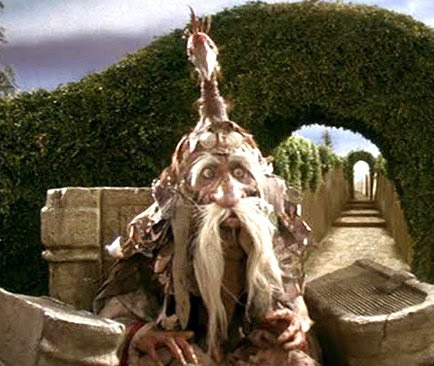
Wiseman and The Hat

There is a sage-type ("Wiseman"), with a talking bird hat ("The Hat"); the sage utters gnomic wisdom (or not), the bird-hat is sarcastic.

Trash-Lady

There is a kind of bag-lady ("Trash-Lady") who pushes memories as a distraction (which again waste time).

Then there are lots of guests at a ball. These appear to be human, but there's an outside chance they're Elves (or Vata) like Jareth. Again though, no pics at The Labyrinth blog.

There are also other sentient beings - the 'Helping Hands', the 'False Alarms', the door-knockers and the 'logic guards' who don't know how their answers work - but these seem to be tied to particular locales. Of course, those above may be too - perhaps the Fireys cannot be found outside the jungle, or the Wiseman outside the garden, but we don't really know. I've pretty much assumed that those with some obvious means of perambulation might move around, those who don't (or whose job keeps them in place like the four guards who either lie or tell the truth) do not and are more like features of the location.

Locations will be what I get onto in the next post, I should think.