Showing posts with label Blue Rose. Show all posts

Sunday, 7 February 2021

Gaming the Labyrinth - the inhabitants

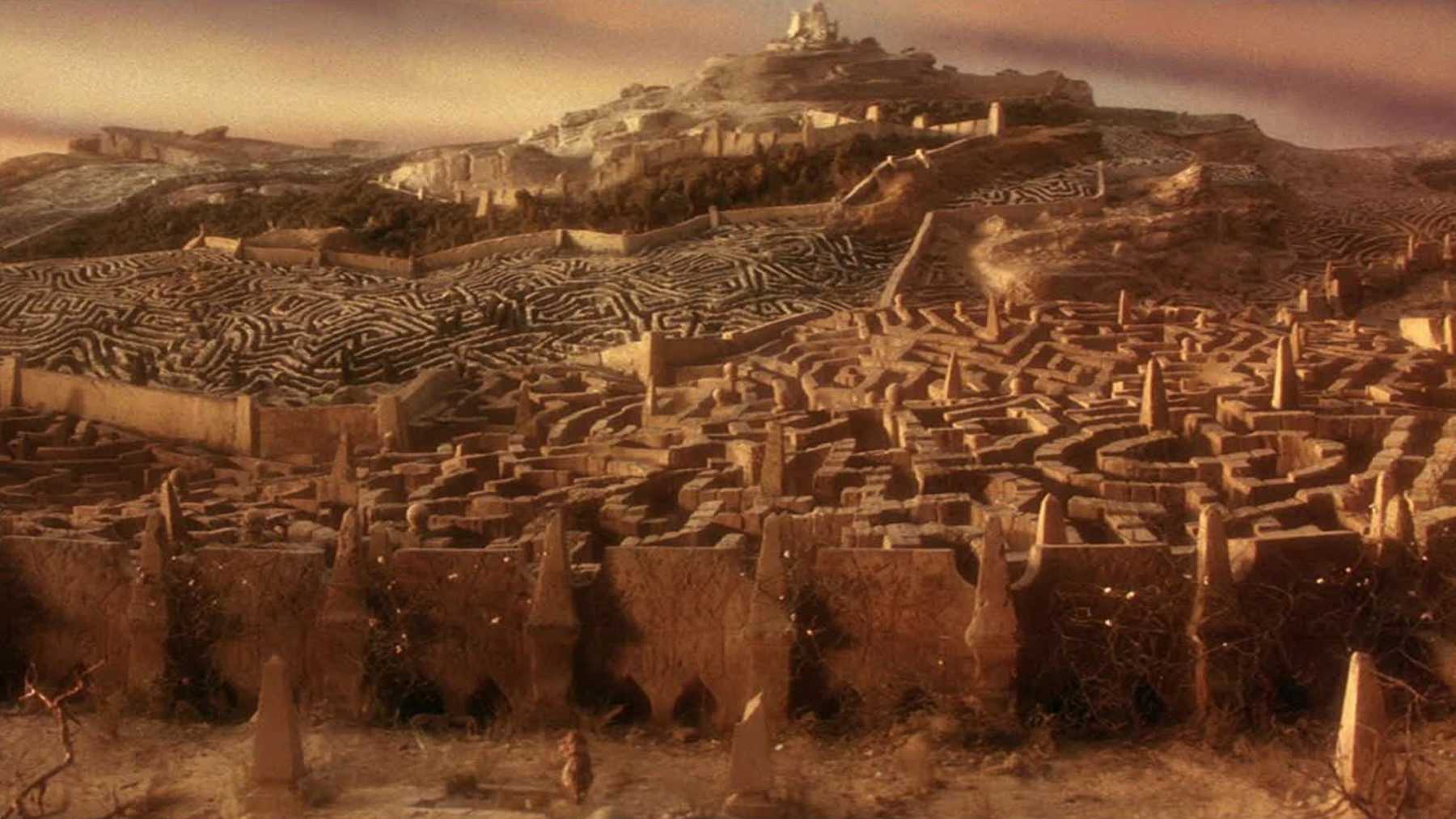
I started posting about 'Labyrinth'. I've made a few notes about the general idea of trying to game it and some of the trickier aspects of how to translate something like the film to something like D&D, or possibly my newly-acquired game, Blue Rose (earlier post linked here). Photos have all been taken from the blog 'The Labyrinth' which seemed like a handy source. I tried to use the pics at IMDB, but they were all tiny so I gave up. It seemed really tedious to find more pics from different sources so I just went there and used what I could find. All photos are (c) TriStar Pictures.

Some of the inhabitants of the Labyrinth, Goblin City and Castle are pretty straightforward to translate into D&D terms. For Blue Rose, maybe not so much, but I'm sure I'll be able to find some ways to do at least some of it when I'm more familiar with the system. I've checked up what some of the characters are called, so will use the IMDB nomenclature.
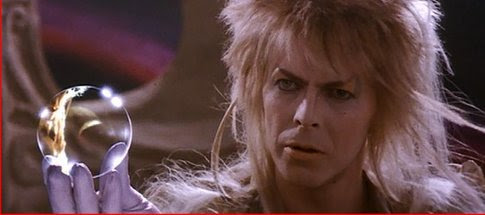
Jareth

Jareth "is an Elf" in my notes. Seems obvious, and specifically, a Dark Elf. Also, sometimes disguises himself as a little old lady, or turns into an owl. He seems to sometimes use this latter ability to travel long distances (so it's a real transformation, not an illusion): at other times his mode of long-distance travel is not clear, but I'm going to assume it's always owl-form. He has crystal balls (steady at the back) which can become a peach with a forgetting spell (which wastes time, a vital resource in Sarah's quest) or a kind of floating bubble. He also has some illusion skills - he seems to transform a bubble into a crystal into a snake into a scarf, possibly then a Goblin... which (if any) are real is difficult to grasp (and the scarf may just fall on a Goblin already there). So they could be actual transformations or illusions. He possibly uses the bubbles to transport others to and from the Castle, but perhaps this is illusion too. If he's an Elf, he has a pretty direct Blue Rose equivalent - he could be some kind of corrupt(ed) Vata (a race similar to Elves; there are two sub-races called Vata'an and Vata'sha. Jareth is probably a Vata'an as they have pale skin and silver hair, which is more like Jareth than the Vata'sha, who look similar to D&D Drow, with dark skin and light hair). Alternatively, he could be a Human with arcane powers, in either Blue Rose or D&D. But he looks like an Elf to me.

Hoggle

Hoggle is a Dwarf who works for Jareth; one of his jobs is as a pest-controller in the garden. He's a coward. He has a spray that kills fairies, likes plastic, and has a (worthless) bag of charms that he values highly. He also has a kind of 'Portable Door' (which he only uses once, maybe only usable once, or perhaps once per day) and knows where to find rope. There may or may not be other Dwarves called Hogwart, Hedgewart, Heggle, Hoghead and Hogbrain. There are no Blue Rose Dwarves.

There are Fairies that bite (no pic of them on the blog where I found the rest of the photos). Hoggle has killed 60, he claims, but we don't know over what time period. He kills about 5 while Sarah is talking to him. A swarm of 10-60 is a possibility, I suppose. We do not know if they're truly intelligent. In D&D they could be something like AC9, Mv 90' (30') flying, hp1, save E1, Att 1 (bite), Dam d4, Ml 9 Al N, I would think. 

'Dennis', the Worm

There's a talking worm, that I decided is called Dennis (he isn't named it seems) who has a wife, drinks tea and knows the way to the Castle. He helps Sarah to identify what we might think of as 'secret doors'. On IMDB he is called "Worm".

Tilekeepers

There are tiny people (about 3" high?) that change the flagstones after Sarah has made marks on them. I have since discovered that these are called "Tilekeepers", but no-one has a credit as a 'Tilekeeper' on IMDB. They are perhaps related to Fairies (they seem to be about the same size) but do not have wings. They do seemingly have language and purpose however.

Goblins

There are Goblins - many and of different sorts, but they boil down to small and tall (mechanically these are probably many Goblins or even Kobolds, and a few Orcs or Hobgoblins, D&D terms. Blue Rose has no real equivalents to Goblins, just large Orcs, who are called Night People). Some Goblins have sticks with small bitey things attached to them. Two small Goblins are 'the Cleaners', who ride a kind of bicycle-powered boring machine. Others are the Goblin Guard, and come in Infantry, Cavalry and Artillery varieties. The Cavalry carry spears and ride two-legged lizards; the Artillery have cannons and machine-guns, and the cannons seem to fire tiny Goblins. Most Goblins are armoured - at least, the ones in the Labyrinth and City. There's also a giant-sized mechanical construct piloted by a Goblin. However, it's probably best to consider this in relation to its location.

Ludo with Sarah

There's Ludo, a kind of Horned Troll with the ability to call d100 rocks (in 13 hours he does it twice, perhaps he can do it 3 times a day).


Fireys

There are Fire Spirits or "Fireys" - there are five of these (No Appearing d6+2?). They may be some kind of weak fire-elemental. Pretty sure I can find some sort of analogue in both D&D and Blue Rose.

Sir Didymus

There is Sir Didymus, an anthropomorphic Fox-knight (other people think he's a dog, but I think he's a fox), who rides Ambrosius, an Old English Sheepdog. Sir Didymus is brave, but somewhat blinkered. Ambrosius is a bit of a coward. Though Blue Rose has rules for animals with psychic communication, it doesn't have rules for foxes that dress like 14th Century Landesknechts, talk as if they're human and hold weapons. In D&D, I might use the rules for Haflings (not as crazy as it sounds... honestly).
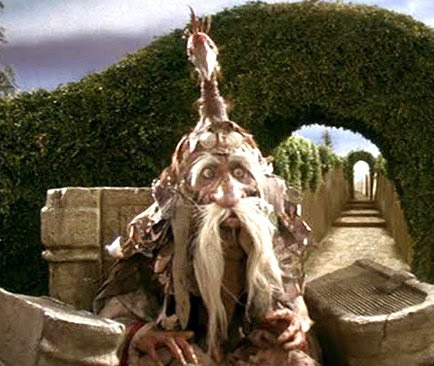
Wiseman and The Hat

There is a sage-type ("Wiseman"), with a talking bird hat ("The Hat"); the sage utters gnomic wisdom (or not), the bird-hat is sarcastic.

Trash-Lady

There is a kind of bag-lady ("Trash-Lady") who pushes memories as a distraction (which again waste time).

Then there are lots of guests at a ball. These appear to be human, but there's an outside chance they're Elves (or Vata) like Jareth. Again though, no pics at The Labyrinth blog.

There are also other sentient beings - the 'Helping Hands', the 'False Alarms', the door-knockers and the 'logic guards' who don't know how their answers work - but these seem to be tied to particular locales. Of course, those above may be too - perhaps the Fireys cannot be found outside the jungle, or the Wiseman outside the garden, but we don't really know. I've pretty much assumed that those with some obvious means of perambulation might move around, those who don't (or whose job keeps them in place like the four guards who either lie or tell the truth) do not and are more like features of the location.

Locations will be what I get onto in the next post, I should think.

Tuesday, 26 January 2021

Gaming the Labyrinth - some thoughts


It was my birthday a few days ago. That's not the point but it comes into the story. There are two reasons for mentioning my birthday - the first is a treat, the second is a present. It's also 5 years this month since David Bowie died. That's not the point either but it may explain some coincidences.

I was thinking that I was going to force my family to watch Labyrinth, because on your birthday, you can maybe insist that people do things that maybe they're not super-keen to do but you can say it's your special treat and they should just humour you.

But, I didn't have to. Two days before, Mrs. Orc was flicking through the channels and suddenly there was David Bowie in his surprising hair and even more surprising trousers, so we settled down to watch it. She didn't mind, she thinks it's a good movie too, and we thought we'd let Orc Minissimus off to do whatever he wanted. He can watch it any time he likes (we have the DVD). And, TV being what it is at the moment, with companies desperate to provide content to captive audiences, four days later it's on again right now as I'm typing up this part of the post. Possibly it's on because, as I say, Bowie died 5 years ago and somebody thought it was a good excuse to put one of his movies on telly.

From https://www.empireonline.com/movies/reviews/labyrinth-review/

Anyway, I started making notes on it because I want to run the Labyrinth (or something like it) as a D&D setting. I tried to note locations, personalities, magic items and whatnot to construct some kid of dreamworld or pocket universe with a similar logic or framework or whatever. I'm not thinking of running this as part of my regular gaming sessions, I think this would have to be a little side-project.

No-one reading this, I assume, is unfamiliar with the film. But just in case you've been living in a pocket universe of your own for 35 years... Sarah's baby brother, Toby has been taken by Jareth and his Goblins. Sarah has 13 hours to rescue Toby from Jareth's Castle beyond the Labyrinth, or he will be lost forever.

One of the most important parts of the film, which perhaps is a bit difficult to get across in gaming, is 'time'. Sarah is on a time-limit and Jareth keeps altering the rules. There are various distractions that eat up time. I suppose, one way of doing this would be to run this as a self-contained session: the Labyrinth must be solved by the end of the session or the PCs fail in their quest. So, turning Labyrinth (or, Labyrinth-like, maybe) into a one-shot.

Obviously, Sarah and Toby come from our world. Not sure how to game that in D&D terms, whether it would be easier to assume that all of this happens 'in universe' or to have a framing where the PCs are actually brought in from outside. I've been thinking a little about portals - (link here). Co-incidentally (maybe not, the point is that it mirrors fantasy literature), 'portal fantasies' are mentioned in the game Blue Rose - this is the birthday present I mentioned earlier, because I have now got a copy of the game. I will be reading it carefully to see what I can draw from it to either inform my D&D gaming or whether it might be better to jump in with both feet and run a game using the Blue Rose rules.

Is it possible to run something like Sarah's journey using Basic D&D? Possibly. But there's a certain amount of what might be called 'alliance-building' that goes on that is difficult to simulate exactly. Sarah's relationships with Hoggle and Ludo, particularly, look easier to 'role-play; than 'rule-play' and that is sort of the point, but also sort of not. Especially for NPCs, reactions should be 'rulable'. All else being equal, if Sarah is kind to NPCs, they should be well-disposed to her. If she is not, they should not be. Jareth may in the end be her enemy but Hoggle, Ludo, Sir Didymus and the other more minor characters should be friendly or not depending on their own motivations and Sarah's interactions with them. There should be a way of constructing systems for developing friendships. Again, Blue Rose has 'Relationship' rules - these I think are more intended for longer-term relationships than the ups and downs of a single session's adventuring, but perhaps there are things to be gleaned from how they handle it. Certainly, part of the charm (for me at least) of Labyrinth is the inter-relationships between the characters that help Sarah to grow as a person. Her relationships with Hoggle and Ludo help her to be less selfish - she's kind to them, and in return they help her on her quest (not it it's about 'returns', because virtue is its own reward, but... having a friend that can summon rocks is certainly helpful). Anyway - alliance-building is a key theme of the film. But whether it's possible to game that in D&D, using the Charisma,  Reactions and Morale rules is something I'm going to have to think about. Several years ago now 'Against the Wicked City' blog had a series of posts (using the tag 'Romance') looking at some of this stuff. I've been re-reading them and hope they'll help me to work out a way forward (there's a metaphor there somewhere). 

There are some things that it's not clear to me yet how to solve. But the inhabitants of the Labyrinth, Goblin City and Castle however are pretty straightforward in terms of their physical abilities (certainly for D&D, I haven't really assimilated Blue Rose yet) - I'll put them in their own post.

So, that's what I'm thinking about at the moment...

Monday, 18 January 2021

Portal Fantasy

This post has been dragged out of the oblivion of 'Drafts', for reasons that will probably become clearer in the not-so-distant future. It's is a continuation of my thinking about how to make D&D more like the literature that inspired it and also the literature that people who might be interested in playing could be reading. 

However, I may be a bit off base here as I don't really belong to the age-bracket or cultural context that didn't read LotR and Howard and Morcock as a youngster... because I did. So I'm not the best judge of what exactly would be high on the reading/watching list of the people who aren't playing but might be... I'm not so familiar with that literature, so in some ways I'm going into this a bit blind.

Anyway, one of the things that is part of a lot of the fantasy literature I do know about is portals, which I mentioned in the linked post. The idea that people from our world venture (often by accident) into another is a mainstay of fantasy literature, TV and film from Alice in Wonderland and The Chronicles of Thomas Covenant to The D&D Cartoon and Stranger Things.

So I'm kicking around some aspects of this question of using portals. I'm looking at the notion of bringing people from our world to the fantasy world to start with.

How does someone from the modern world survive? Classing modern people in D&D terms is tricky.

People from our world will generally be human - unless they have also been transformed while being transported, in which case anything is up for grabs. I can't think of a work where someone's body changed by going through the portal, perhaps there are. More likely that the journey releases unknown abilities (you can't do magic in our world but maybe you can by travelling to 'Fabulosa'? Can't think of any works where that specifically happens but it seems like there would be some. Certainly in the Fionavar Tapestry there is a certain amount of 'magic acquisition' but I'd have to re-read them to work out the particular causes). That might have  a bearing on what class you could be in the new world.

I can't think of a single portal fantasy where the transportee(s) did not speak the language. Red Moon Black Mountain, the Fionavar Tapestry, Chronicles of Narnia, Labyrinth, Magic Kingdom for Sale - SOLD! and The Wonderful Wizard of Oz (which to my chagrin I've never even read... though in my understanding the film doesn't depart massively from the book) wouldn't work if Mr Tumnus, Oliver, Loren, Dorothy and so on couldn't communicate. So for starters, the transportees speak 'Common'. Any other languages one might speak in the real world are superfluous. So what if you know English, French, German and a bit of Spanish? Only one of those equates to Common, the others don't exist. Dwarves don't speak Icelandic, Elves don't speak Gaelic. Probably. Though as they're both pretty conservative languages perhaps if the portal takes you back to 10th-century Norway or 5th-century Ireland, maybe the Dvergar and Tuatha de Danaan do speak a recognisable language. But, if you're in 10th-century Norway or 5th-century Ireland, you probably still speak 'Common' - which therefore would probably be Old Norse or Old Irish anyway.

What about skills? Most things modern humans know would be utterly useless. However, we have a much better understanding of stuff like communicable diseases and infection than people living in our own past and that might be a useful survival skill if transported somewhere Earth-like. Most of us I guess know a few things that might be considered somewhat arcane in a different world, like how to make steel by adding carbon to iron, or how to distil vodka. In general terms we might know more about meteorology, astronomy and such like (especially as regards Earth - portals to completely different world would render such knowledge more problematic) but in practical terms we would know less. 

Generally, non-physical skills are a bit more problematic than physical skills. Things like Mixed Martial Arts, archery, and various types of sword-fighting might equate fairly well (though if you're trained with an epee and then get a broadsword maybe not), and some things like being able to chop down a tree with an axe or hunting in the forest would be good for many 'fantasy' settings but otherwise, the sorts of skills that it would actually be beneficial to have are often going to be non-gaming ones. Woodworking and such like, though very practical in a real-world setting, are not exactly skills that feature high in character classes for D&D.

Thief skills are not really a problem. Picking pockets is picking pockets (and sleight-of-hand and misdirection play a part here too I think). The Thief skills seem to be among those that it might be reasonable to directly import.

Unless (see above) the transportation process sets of latent magical talents, Magic Users and Clerics will not be applicable here. Could a devout religious person from our world, whether through faith as an internal mechanism, or from an external source (some god), derive power that enabled them to be a Cleric? Maybe. But I can't see how a Magic User could exist.

Many of us are going to be less fit than people in the past, but conversely - perhaps - more healthy. We often do not lead such active lifestyles as people even 30 years ago, let alone 300 or 3,000. But we don't have anything like the prevalence of rickets, scurvy, polio, leprosy, smallpox or numerous other diseases or other complaints. A year into a global pandemic it seems odd to claim that we're healthier than previous populations but if you went back to Europe in 1349 and talked about a plague that killed 1/1000 of the population, the 60% of the population that survived the Black Death would think you were very, very lucky.

But perhaps some of this is not so relevant. Sarah only stays in the Labyrinth for 13 hours (actually less as Jareth keeps advancing the clock so maybe it's more like 9 hours). Yes, language is pretty fundamental to interact with the inhabitants, but perhaps disease resistance is not so important. The Fionavar Tapestry is perhaps the most 'realistic' attempt at the portal fantasy I can think of, but even then the 'party' (for want of a better term) don't all come down with cholera from drinking polluted water.

So there are problems to say the least with using D&D as a baseline for how you could do this kind of thing in a game, in terms of character generation and classing. Probably not a problem to establish basic stats: STR, INT etc are fairly generic categories, but if you've ever tried to convert D&D to be a space-game engine, for example, it's maybe a bit limited. However, 'how to do magic' is a problem that needs addressing for those classes.

There are a lot of other considerations around portals. I'm sure I haven't even considered a bunch of important factors.

A fundamental question - Who or what has brought the PCs to this world?

a Good Deity
an Evil Deity
a powerful Good Wizard
a powerful Evil Wizard
an accident
an ancient spell
a book or scroll
an ancient magical device
a secret portal (mirror, pool, wardrobe etc)

Not sure if this list is particularly exhaustive. Sometimes there can be more than one answer. An accident, for example, may involve an ancient magical device or spell gone awry. The PCs might be the unintended passengers of a spell meant for someone else, either from a good or evil entity. An Evil Wizard may use a spell or device to trap a questor, etc. Alternatively, an ancient magical device may have been created by an Evil Wizard. So the point of this list is more a 'first cause' than a set of exclusive possibilities. It's probably worth delving into deeper levels of answer that depend on the initial one.

I've just acquired a copy of the game Blue Rose which has a section on using portals in games - I'm going to be reading that section with some interest (along with the rest, of course - I didn't want it just for that section!). I hope, as it's actually part of the fabric of the game, that it might be easier to sort some of this stuff out

So, yeah... portals... they're a thing. Not a huge part of what I'm thinking about right now but I guess connected. It's sometimes difficult to know exactly where to put all the speculation.