Monday, 19 January 2015

New start for the intrepid explorers... Tower of Zelligar nowhere in sight

The boys have attempted another evening of D&Ding after the catastrophes of the previous sessions. This time around, instead of rampaging off into the wilderness they decided to try to get some jobs round town. And what could be better than the suggestions for 'Things to Do in Threshold when you're Lvl 1', found in the Mentzer Expert Set? I should point out here that I'm in the perhaps unusual position of discovering D&D in the period 1981-3, so though I have Moldvay Basic, I have Mentzer Expert. And B1, which is pre-Moldvay. And some AD&D stuff. Yeah, right, nothing quite fits together. Doesn't matter, half of what I used to run was Runequest anyway.

The first thing my eye lighted on at the end of the previous session had been a (literal) bug-hunt scenario where one of the warehouse owners in the northern part of the island near the Old Mill was on the lookout for hardy souls to clear out the cellars of his property. The PCs - two Dwarves and a Fighter - decided that might reasonable enough work and would set about trying to get the contract.

Threshold, from Expert Rulebook (c) TSR /WotC 1984


The evening we decided to play, however, I hadn't been told that the guys were going to turn up. Half an hour before their arrival, I was hurriedly scanning the D&D site for some maps and downloading random lists of human and Dwarvish names and ale-house descriptions from Donjon.

I dug out the sketch-map I had made of the northern part of the island and the quick notes I had on the bugs I'd planned for (I wasn't completely unprepared, but I'm glad they decided to stick to the plan from the previous session) and we were good to go.

Except of course for the unusual problem of Threshold bye-laws, that is. Weapons not allowed in the town, that's what I told them. They were hanging around by the South Gate, chatting with the guards. Two of them decided that they'd hand over their weapons, the other decided to wait it out. The two who were in town went to see the innkeeper who'd told them about the contract in the first place, and then went off looking for Beren, the old fellow who had a bug-problem (I had generated his name at the previous session rolling on the Periodic Table, and I thought Boron was wrong somehow). Having found him (and met up with a few NPCs in the tavern, including - because they'd been on the random tavern print-out - three members of what was conceivably the Guild of Sages and Alchemists), they went back to their comrade.

In the meantime, knowing about the contract but not that his comrades had met Beren, the PC still at the gate requested entrance. The Captain of the Guard was fetched to decide if this disreputable adventurer-type could be allowed in with weapons. While being questioned by the Captain of the Guard, said adventurer made some sarcastic comment. That didn't go down too well with the Guard Captain - who, up until that point, had been rather inclined to let him in. Words were spoken, tempers flared - and when the PC attacked the Guard Captain, once more one of the PCs ended up rapidly dead (if you're Lvl 1, don't attack 5 Lvl 3 fighters armed with crossbows and/or longswords).. By the time his companion had come back with firm details of the contract, his corpse was already nailed to a plank outside the Town Hall with a sign round his neck reading 'Disturber of the Peace'.

Long story short, the surviving PCs were joined by one of the NPCs from the pub (now firmly located at the west end of North Bridge, a little square building on the Threshold map) - a mysterious lady in a large hat who, it turned out, had Thief skills. They made their way to the warehouse and descended into the cellar. But - somewhat weirdly - they took no torches. OK for the Dwarves but what Mistress Thief thought she was doing I don't know... a bit of blundering later and they were attacked by Robber Flies. In the dark. Though the Dwarves managed well enough, Mistress Thief had her face munched off. Not for the first time, I wondered if the lads had really got to grips with how they should be organising themselves... once we start playing again, they've only got a few minutes to do some first aid or she really will be dead.

Thursday, 8 January 2015

The Gallery of Statues

Greg at Gorgonmilk, it's all your fault.

This is part of Greg's project to build a shifting Borghesian 'meta-dungeon', possibly the home of Stheno the Gorgon.

 
Statue of Stheno from https://www.pinterest.com/mermaidsofearth/mermaid-statues/ - I don't know how to use pinterest but you can find this image there anyway

 
I really like Greg's idea here: the notion that the geography shifts around the explorers. Even if you manage to find your way back to a room you visited before, there's really no guarantee that the exit(s) from the room - even if it is the same room - will take you back the way you came.

In fact, it's not certain that it's actually the same room, or a different version of the room, or the room at a different time, or an imperfect memory of the room the party left, or what exactly is going on at all. I really like all that uncertainty.

So, I built some rooms - 2 so far - for the dungeon, or villa, or whatever it is. These can be found over at the Gorgonmilk blog.

Both rooms use random elements. The first - the Room of Mirrors - uses some random mutation tables. I'm sure these are readily available - though a quick search has left me unable to find any suitable tables. Maybe I need to do my own, or maybe I need to look harder. Two tables are needed - one for cosmetic mutations such as changed skin colour, and another for more serious mutations such as snakes for arms.

EDIT: I've now made some tables that can be accessed from Seventh Order of the Random Generator, under 'Mutations', the 'Major mutations' and 'Minor mutations' tables, or access them direct from here - Minor Mutations and Major Mutations

The second room has variable and potentially randomised statues. Though my post to Greg's blog is quite short, I did a much longer post with a bunch of random tables for the creation of the statue set. I also ran through an iteration to actually produce a single room. However, for the purposes of posting on Gorgonmilk, I thought the bare-bones version made the most sense.

I will be putting the full thing into a dungeon somewhere. I haven't decided exactly where but by its very nature it will be at some kind of planar junction. Time and space are different here. Anyway - for what it's worth, here's the iterated version, which may be dropped into any dungeon fairly unproblematically.

The Gallery of Statues 

This room is around 40’ (12m) long and 15’ (4.5m) wide. The room is a kind of hall- or church-like structure: it is taller than it is wide, around 20’ (6m) at the walls and taller in the centre. The doors open into a kind of long gallery with raised platforms to either side, lined with tableaux that resemble statues of Greek myths found on the Parthenon friezes. Above the statues is a row of small windows, 6 on each side – no matter whether this room is in an underground complex or wherever else it may be encountered. If the characters can somehow gain access to them, they will see that those on the right of the room look out on a garden at night, while those on the left look out on a beach by day. Both the beach and the garden appear to be dotted with statues, much like the room.

In the room, there are 6 tableaux on each platform, with single, paired or multiple figures in each. The tableaux on the left side of the room appear to be of white marble, and the statues on the right side seem to be made of black marble.


B1 – a male Elf in leather armour, with a sword and shield, is fighting a female water-spirit wearing a ripped tunic and carrying a short-sword 

B2 – a winged female being clad in long and flowing, though revealing, robes and wielding a spear, attacks a naked male Elf, while a naked female Orc tries to protect him 

B3 – two female Elves, wearing only full-face helms and short skirts, and wielding bows with silver arrows, are fighting 5 winged male beings wearing leather armour and equipped with swords and shields

B4 – a Dryad, naked but for a helm, armour on shins and forearms, with a scabbard on a baldric, and carrying a sword and shield, is trying attack a naked female Elf; a Boar is attempting to defend the Elf from the Dryad

B5 – a male Orc in tunic, chain, helm and with a sword and scabbard is attacking a Giant Snake; a female winged divine being, naked but for a full-face helm and short skirt, and armed with a bow and 6 silver arrows, attempts to defend the snake

B6 – a naked male Human is attempting to overpower a semi-naked female Human

W1 – a Naiad, clad in a single piece of flowing silk, carrying a net and with a living snake for a belt, looks on warily

W2 – a semi-naked, winged male divine being and a semi-naked female Elf are trying to seduce each other

W3 – a semi-naked Medusa and a semi-naked Nixie are eating and drinking

W4 – a group of six Harpies attacks a similar number of female Elves wearing ripped tunics and carrying short-swords

W5 – a male Elf, naked but for a living snake around his neck and carrying a two-handed sword, fights a female Elf wearing only a helm, and armour on her shins and forearms, and a scabbard on a baldric. She carries a shield and sword

W6 – a semi-naked female Elf plays a musical instrument

The figures in the tableaux are real, but to the casual observer, will appear stationary. They are engaged in the activities depicted in the tableaux; they will continue to do these activities forever – seeing them move very slowly will require a Detect Secret Doors roll. The tableaux do not interact with each other, or with onlookers, except under very specific circumstances. Characters can interact with tableaux only by climbing onto one of the platforms.

In this case they can join in with whatever activities are happening on that platform. Once up there, characters see everything in natural colours – the marble statues now seem perfectly real, the middle of the room with their friends is indistinct and the opposite side of the room is practically invisible – the ‘white’ side seems flooded with blinding light when seen from the ‘black’ side, and from the ‘white’ side, the ‘black’ side is shrouded in darkness.

If there is a fight, characters can join in, though the statues are very hard to hit – only a natural 20 of any attack will harm a statue (no matter what the skill or level of the character). Magic weapon bonuses (but this is all) can increase the chances to hit as normal. Each statue has d6 damage points; each successful attack will only do 1pt of damage (no bonuses will be applicable). Dead figures will become statues of the dead, to observers. It is up to the DM to decide what effect spells such as 'Stone to Flesh' or 'Petrify' might have, depending on whether the DM sees these as animated statues or petrified humans etc. Likewise, it is up to the DM whether magic weapons specifically designed to smash stone or harm stone constructs may slay these living statues on any successful d20 hit.

However, each side of the room will only ever have as many figures as it started with. For each character that joins a tableaux, roll a d6 every 10 seconds. If the number is equal to or lower than the number of 10-second segments that the character has occupied the tableaux, one random figure from that side of the room will step off its pedestal and attempt to leave the room, taking anything portable that it had as a statue with it. If this is a single figure, another figure from a neighbouring pedestal will then step onto the vacated pedestal. This new arrangement will then be the same on subsequent visits to this room (if that is possible), unless characters further interfere.

White marble figures from the left side of the room will leave from the doors at the far end of the room; black marble figures from the right side of the room will make their way to the doors the characters entered by. The figures seem uninterested in the party and are merely trying to leave. If characters attempt to stop the figure, it will either fight or attempt to seduce them – using natural abilities, 'Charm' spells or any other suitable method – in order to be able to leave. If the PCs fight a figure before it leaves the room, it will have normal characteristics for a figure of its type. It should however not be any kind of pushover and will in general terms be as tough as the toughest character facing it (even if it’s a naked Nixie for example). If it is armed, its weapons will be as effective as well-made magical weapons (though not of Godly quality - say +2, or give each weapon a unique ability). If ‘killed’, the figure will shed any weapons or other portable objects it has while attempting to crawl back to its pedestal. In this case, the original character trapped on the pedestal can, with a successful save against petrifying magic, Wisdom, Will or Luck roll or similar, break free of the enchantment. If they cannot do so, they can keep trying though the GM should roll a d6 as before for each 10-second segment – and another figure could then step down. Any objects that a statue has been forced to drop are magical and have appropriate characteristics – musical instruments give the player (whoever that may be) the ability to cast Charm or Petrify spells, weapons are approximately equivalent to +2 to hit (or have unique abilities), water pitchers will never run dry and can heal wounds once per day, etc.

If the figures leave the room, there is no way that they can be compelled back or even found again, short of divine intervention, and no way that characters can leave their new pedestals, short of someone else joining the tableaux. In this case the character can leave if they make a successful Save as described above. Otherwise, a random roll is made as before and a figure (which may of course include the original character) will step down. It is up to the DM if any other method, such the party pitching a statue they may have found onto a platform and hoping that it animates, will be successful in releasing a character trapped on the platform.


Sunday, 4 January 2015

The Observers' Book of Monsters

I've been quite excited by the posts on The Disoriented Ranger that Jens has been posting about his new idea, ''The Lost Song of the Niebelungs". It seems to me that what Jens is attempting to do is to tailor D&D for a Volkswandrung/'Dark Age' setting of Seigfried, Beowulf etc.

Because Jens is doing hard stuff like trying to see how character advancement works and trying to find suitable names for attributes, whereas I just do crazy things like tell him heroes need to be adopted by Dwarves, I'm just riffing off the idea of setting a game in Early Medieval Europe. That was one of the settings I tried to make D&D work in, back in the day, as an 'Arthurian' campaign.

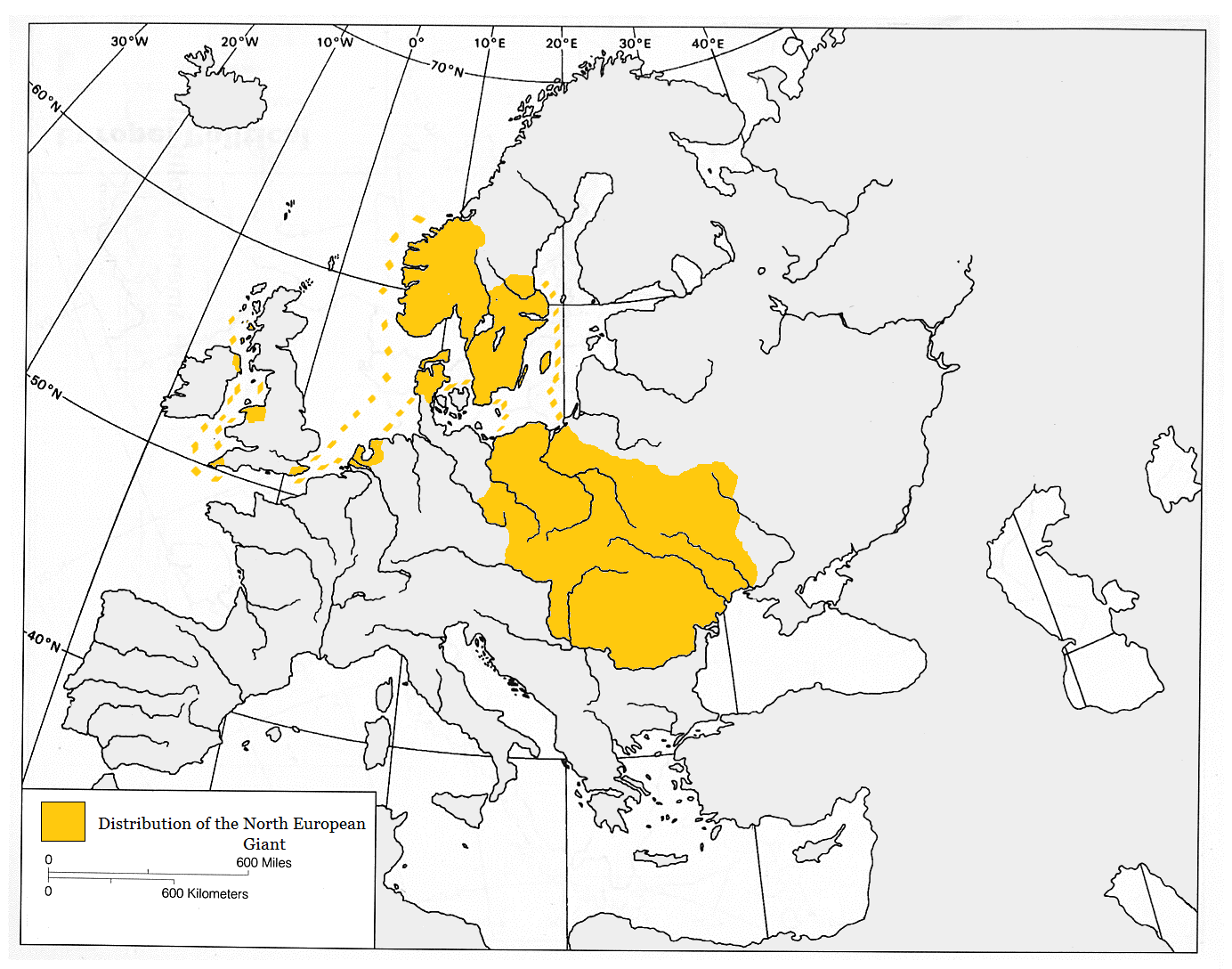
So, because I can just make stuff tangentally connected to someone else's project, I thought I'd show some of my latest silliness. I have made some maps for a hypothetical 'Observer's Book of Monsters'. For those who don't know the Observer's Books, they were a series of field-guides to various subjects (Birds, Aircraft, Football...) published in the UK from the 1930s onwards. And thinking about what monsters might live in different parts of Europe (for Jens' game, of course) got me thinking about how to show the distribution of monsters and thus the 'Observer's Book of Monsters' was born... a new topic which I'm going to be adding to over coming months I suspect.


Maybe not terribly accurate but I had fun making them. I am quite prepared to consider doing this in a more disciplined and organised way, however. If anybody wants to say 'no! What you have failed to take into account is the Spanish Centaur found in depictions from the 3rd Century BC from Guadalquivir...' or whatever, I'm quite prepared to listen.

I'm not looking forward to mapping the distribution of the European (or Common) Goblin however. I suspect that's 'all over the place'.

Thursday, 1 January 2015

The College of Speculative Antiquarians: The Story of Otto Kleinhund, Part the First

 I'm re-blogging this from one of my other blogs, with includes more theoretical or speculative stuff than my 'straightforward' gaming activity usually included here.

It's the first part of a short story, set in the Warhammer world, dealing with some speculations about the relationship between official and more underground history, and may be of some interest to the Oldhammer crowd.


The College of Speculative Antiquarians: The Story of Otto Kleinhund, Part the First:

Otto Kleinhund sniffed the air issuing from the trapdoor.

"You say no-one has been down here for more than 20 years? I would believe it, Master Wilhelm." He took a torch from the massive slab of a man to his right, and began to descend the rickety ladder, nearly setting his straggly beard aflame as he tried to hold the torch, while gathering his ornate robes to avoid tripping on the staircase, whose side-rail he was also attempting to grip.

"Perhaps, Kleinhund, you should drop a torch down first?" suggested the aged Master of the College of Speculative Antiquarians, a lesser-known cousin of the Guild of Historians.

"I would, Master, but the steps are made of wood and there may be parchments in the room," explained Kleinhund, after a moment's thought.

"Ah, I see, might need to fight them off, you mean? Good thinking," replied Master Wilhelm.

Kleinhund stared at him. "Parchments?" he asked.

"What? Parchments? Sorry, I thought you said trolls. Anyway... carry on." Having grown bored, Master Wilhelm wandered away, back towards the better-lit corridors of the ancient and crumbling College. He beckoned the large man who'd provided Kleinhund with his torch. "Come, Dorothy, there's a wardrobe I want you to move. I think it has a witch in it."

Kleinhund stared at the two backs slowly receding down the corridor. "Well, this is it, my old son," he said to himself, "you knew you'd be on your own in the end. When you come out you'll either be a hero to historians everywhere, or a laughing stock to any man who can write his own name." A horrid thought struck him, causing another pause. "Assuming you do come up that is. Here goes..." and he rattled down the rest of the ladder, into the musty dark.

Sunday, 28 December 2014

More on 'Dragons & Dungeons', and a new Euro-game

Firstly, I should mention the post that inspired all of this, from Porky's Expanse! - 'Dragons & Dungeons'. This was an attempt to think about the relationship between monsters and setting, in which Porky wondered how things would have been different if the conceptual order of 'Dungeons & Dragons' had been reversed - if instead of a dungeon (space) that we filled with dragons (monsters) we instead started with the dragons and took things from there. Porky's original post, and the comments made on the responses, delve into philosophy and futurology - while most of those commenting stick firmly in the realm of games, which shows I think that Porky's imaginative scope is far beyond that of some of us (certainly me).

Then, my response over here to some of these ideas - 'Thoughts on 'Dragons & Dungeons' - which is an attempt to create a mini-dungeon from ecological rather than spatial principles, in line with the idea of thinking about how the monsters inhabit space, rather than thinking about the space and then filling it with random encounters. I'm quite impressed with how I ran with the idea and generated somewhat startling results from the relatively simple process of getting some monsters and really thinking how they 'live' together rather than just putting some numbers on a map and keying in pseudo-random encounters that way.

But now I want to look at a different way of examining the question of inverting the relationship between monsters and setting, one that we've kicked around as a concept already, but I'm going to mention a mechanism. Instead of a set rooms and random monsters, the idea was suggested for set monsters and random rooms. In other words, instead of building an environment and randomly generating inhabitants through a random monster table, the suggestion was for building an ecosystem, and then generating a random environment through some kind of 'random rooms table'.

Well, yesterday some friends came over who, like me and my partner, are big fans of games like Carcassonne, Alhambra and Settlers of Catan. They brought a lovely-looking game with them called The Castles of Mad King Ludwig (which I notice, in German, is called 'The Castles of King Ludwig' - perhaps calling him 'Mad' King Ludwig isn't considered polite in Germany, I don't know). The idea of the game is similar to Alhambra - the players are competing with each other to build castles (for King Ludwig, each player being literally a builder) by buying 'rooms' which are offered for sale through a semi-random process.

Illustration from BoardGameGeek - Castles of Mad King Ludwig, Bézier Games, 2014 — sample layout (image provided by the publisher) - link above


The game features around 80 tiles which are rooms of different functions - observatories, gardens, dining rooms, armouries, dungeons, fungus rooms - but, unlike Alhambra, also different sizes and shapes, ranging from small rooms (approximately 20' square?) to huge ones (perhaps 12 times the size of the smallest, around 60'x80' maybe?), that are square, round, oval, L-shaped and rectangular. They're a bit like the old 'Dungeon Geomorphs' that used to be around back in the day, but they actually have room names on them.

Because there is a randomised element to the game, also included is a pack of cards which more-or-less corresponds to the shapes/size, and therefore cost, of the rooms (all L-shaped rooms cost the same, but not all L-shaped rooms are the same type; all small square rooms cost the same but again are of different types). The cards are used to determine which room shapes are offered to the players each round. In theory the cards could be used to 'build' a dungeon through a process of randomising which room-shape comes next in the random sequence. There are also stair and corridor pieces to link levels and sections.

However, the cards do not match the rooms exactly - there are fewer cards than rooms, presumably so that some (random) rooms are always left unused (otherwise one could always go 'I'll hold out for the Observatory' knowing that it was bound to appear - this way there are always some room tiles that won't appear but there is no way of knowing which). Also, there is no way I could see to determine which type (as opposed to size/shape) of room could come next. I haven't closely examined all the pieces however, so I don't know whether it would be possible. But even if there isn't a way to do that, a random process which included all the possibilities (say, 'random room' tables for surface and sub-surface rooms which between them included all the options, perhaps more than once) could allow a randomised space in which a designed monster set could live.

If I bought it, it would of course be to play as 'The Castles of Mad King Ludwig'. If I could also use it as a 'random room generator' though, that would be an added bonus!

Monday, 22 December 2014

Orc-town - 4th Level lair - initial thoughts

Because there hasn't been much adventuring going on lately (probably something to do with me wiping out the party, I don't know), I'm posting once more about Silvergate. Recently I described the random (and somewhat unexpected) creation of a large lair of Orcs on the 4th level in this post here. About 640 of them, all together, with a fighting strength of around 160, and a couple of Trolls.

That sort of thing isn't necessarily easy to just slot into a corner of a level. 640 Orcs take up a lot of room, so I am in effect designing a lair the size of a small human town around the idea of an Orc-tribe holding a section of the Dwarf-city.

I need to think about a bunch of things:

food
water
waste
fuel
non-food/fuel supplies (eg wood for tools, weapons etc)
clothing, rope, leather straps etc
patrols
social activities (religious rites, community gatherings)

This I think relates in some way to this post about dungeon ecology. How do monsters relate to each other, and what are they actually 'doing' all the time? How do they live? What do they eat? Where is their water coming supply coming from?

More specifically, are these Orcs producing their own food from their territory? Are they essentially 'farming' a section of the dungeon (eating rats and fungus, for example)? Do they hunt for food in the caverns? Are the patrols they send out 'guards' or 'hunters'?

Presumably, their massive quantities of Orc-slurry become the food for something else, which then becomes the food for something else, which is then eaten by the Orcs, and thus the cycle of life continues. But presumably there are some inputs into the system from outside - unless these Orcs are completely self-sufficient. So the idea of sending out regular patrols of Orcs to both sweep the corridors and hunt for food, or strangers who might trade/be robbed of wood or other valuable surface-items seems reasonable.

These Orcs would perhaps see wood as too useful to burn - unless, of course, it's so valuable as fuel to that they don't make mere clubs and spears out of it. Either way I'd expect that they'd be making things out of bone, keratin, chitin etc. Likewise, though they can make leather from rat or lizard skin (for example) perhaps the Orcs would also be using Giant Spider silk for ropes or straps and maybe they've even learned to weave it into fabric.

Without a source of a lot of fuel, iron-working is going to be very difficult so metal weapons are going to be in short supply, unless someone outside is supplying them in exchange for something else. Perhaps along with the bone and chitin, the Orcs are goingto be working stone rather than metal. I think the trick is going to be to pick some things in which the Orcs are self-sufficient and some others that they have to acquire from outside their caves.

There will definitely be a source of water, of that I am absolutely certain. There are several potentials here. The city when it was in its heyday was heavily-populated and the Dwarves were water-engineers. Some aspects of this water-management system survive so maybe the Orcs inhabit an area where the water comes from the Dwarves' plumbing. There are cisterns and conduits - perhaps some of these still work, or perhaps the breakdown of this system just means that some rooms are partly-flooded and these areas become 'watering holes' - either guarded by one faction, or used as a 'neutral space' by different factions.

Food doesn't seem to be too difficult. There are plenty of things that Orcs could eat, that don't necessarily have to appear on the Wandering Monster list or in lairs. Animals, plants and fungi only really need stats if they're a threat to the PCs. Something that can't harm the PCs, but is no use to them either (like a giant woodlouse that is poisonous for humans and Dwarves but Orcs find palatable, that can't bite through human skin) doesn't need a stat because it's more like a part of the room description than a 'monster' as such.

Working with these kind of notions should allow me to make the Orc-lair a recognisable part of the megadungeon, without necessarily having to tweak the results of my random rolling too much, which I'm loth to do, as I'm trying to run the creation process as 'straight' as I can get away with.

Wednesday, 8 October 2014

Tower of Zelligar session 4: TPK = I'm a terrible DM

Well, it happened - TPK, due to .... everything.

I've been trying not to fudge rolls - maybe I should have done. When the party strayed into an area patrolled by undead (a kind called 'Brothers of the Pine', which are a sort of druidic forest zombie about as tough as Ghouls; I found them in old White Dwarf scenarios but I don't know if they were ever officially adopted, eg in 'Fiend Folio') I rolled a random encounter and... a lot of them turned up. Too many for the party to deal with anyway. Maybe I should have tried to adjust the numbers or give them another way of avoiding the encounter or both.

The party didn't capitalise on the advantages they had - the Brothers of the Pine are particularly susceptible to fire and the party had a campfire; if they'd taken burning branches they would have had fairly efficient weapons against the Brothers. Only one of the party attempted to do something like that - throwing his flask of oil at one and attempting to light it. Great idea on Tuh's part, but he failed to do so first time. Throwing the burning brand probably wasn't as good an idea as holding one end and fending off the flammable undead with the other.

Jericho the Elf used his Magic Missile on one; he could have probably used his Web scroll on some of the others, but he didn't. That meant that within a couple of rounds the whole party was under sustained attack, instead of trapping some and dealing with the attackers piecemeal.

The Brothers kept rolling high for their attacks - several 18s and 19s - while the party kept rollings 7s. Not that it mattered, the party didn't have enough magic weapons to deal with the Brothers anyway. The hits they did manage - Grrk's strike with his shortbow against one for example - didn't work. When Sir Norrin hit one with his magic sword, which should have worked fairly well (not as well as fire though) he didn't do very much damage because he rolled low. Fire was their best friend in this encounter and they didn't use it.

One after another, the members of the party were cut down under the swords of the Brothers. First to fall was Bork, then Tuh, and finally (as far as the PCs were concerned) Jericho. After a moment of stunned silence, and then some laughter, the players wanted to see how Sir Norrin, Grrk the Squire, The Mystical One (First Level Cleric and therefore no use at turning them, in the description I've got it says they're equivalent to Spectres but I pegged them at Ghoul status which is still really tough at First Level), and the permanently-injured Mohag the Wanderer managed to fare.

Not well was the answer. PCs and NPCs all butchered in a couple of rounds and, according to the description, ready to be filled with sap and turned into new Brothers - and Sisters in The Mystical One's case - of the Pine. A combination of my bad DMing - sticking to the Number Appearing roll when I knew that it was going to be very tough - the party's panic - not using their spells as well as they could and not capitalising on the fire as a source of effective weapons - and just unlucky rolls meant that everyone died.

So, the surviving members of the party were Yor, the Magic User who fled in session two, and Betsy the horse, who ran away in the midst of the fight with the Brothers. She will, presumably, after many adventures, turn up at South Reach (Sir Norrin's manor) riderless, and with a sack of Giant Spider-legs in her saddle-bags, much to the consternation of the servants there.

The lads have rolled up new characters. They've also decided that they want a trip to the sea-side so these PCs look likely to be leaving Threshold and the mountains behind them and heading south towards the coast. It's a wild place, the Grand Duchy; they won't be short of adventure as they travel through it. Hopefully though they might get to the seaside before they all die.