Sunday, 29 May 2016

Seascapes, myths and the Thyato-centric view of the world

I didn't know about the 'Sea of O'SR' project when I wrote the first of my 'Fortunate Isles' posts and invited other people to contribute - if I had known, I'd probably have just added my input to the Sea of O'SR. The basic motivation (though not necessarily the execution) seems very similar. It's a shame that the Sea of O'SR didn't attract more entries - I think it was a great idea! I now want to play a whole Legend of Zelda: Windwaker/Odyssey-style campaign where the PCs visit loads of islands.

A particularly lovely version of the Zelda: Wind Waker map from https://www.behance.net/gallery/17865223/Legend-of-Zelda-Wind-Waker-Great-Sea-Map

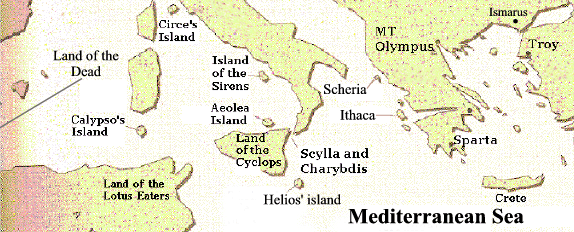
Odyssey map from here: http://www.irasov.com/odyssey_map.htm
A big chunk of the mythology and history of my version of Mystara is derived from Greek myth. Several analogues of Greek gods exist in the Thyatian-Minrothad-Karameikos area. A giant minotaur lived in a maze under the city of Minrothad, until it was slain by the Duke of Kerendas, who resembles Theseus in many ways (and I'm considering calling minotaurs 'minrotaurs' in this campaign); a young nobleman exiled from Tel Akbir has sailed to the ends of the earth to bring back a powerful healing artefact from a distant city-state; the Emperor of Thyatis is on the point of declaring war on Ierendi, using as an excuse the fact that the son of the King of Ierendi has kidnapped the wife of his brother, the Duke of Biazzan (she went willingly, the real cause of the war is the campaign of piracy that Ierendi has been unofficially conducting on Thyatian and Minrothadi shipping - and I'm sure, at the end of the war, a clever Duke from an insignificant Thyatian island will find it very hard to get home).

In short, in my campaign-world, the northern part of the Sea of Dread and the sea to the east of Thyatis, Ylaruam and the northern kingdoms are the Mediterranean and Black Sea - only they run the other way round: Greece is in the south-east, but the lands of the 'west' (Gorgons/Medusae, Sirens and Circe) are north-east, and those of the 'east' (Troy, Colchis, Persia) are to the west. Clear? Probably not...

Maybe I need to do a map like Ptolemy's
Ptolemy's map from here http://www.mappery.com/map-of/ptolemy-world-map
or even the the reconstruction of Herodotus's world-view  - only it would be the world as seen from the Imperial capital. Or is that what the Mystara map is? Accurate for Thyatis, Ylaruam and the immediate islands, more and more speculative as we get further from the Imperial City? That could be fun, if when they get to the northlands the players find they look like northern Harn or the map from the Thomas Covenant books...

Thursday, 12 May 2016

Who was it who was asking about destroying their campaign?

A while ago, I was reading on someone's blog a post about what it would take to (potentially) destroy the campaign-world. I can't now remember who it was, unfortunately, but it did get me thinking. Then, after thinking, I did nothing about it for ages, but I've now decided to dust down this post and put out.

Obviously, the idea of the DM just delivering an apocalypse and the PCs watching helplessly is a nonsensical one. The PCs must have some agency in all of this. So, I took the question to be about the sparking of a series of events that would, without the PCs' intervention, potentially lead to the destruction of the world.

There could be many reasons for this. A colossal being (ur-dragon, star-god, whatever) might be awakening at the centre of the world and the PCs need to put it back to sleep (or kill it). A crazed cult may be trying to melt all the ice and flood the whole world for stupid and/or nefarious purposes (or is that just too preposterous?). But, partly because I'm a big fan of the Zelda games on Nintendo, I went with imagining a D&D spin on the classic Evil-Moon-Crashing-Down-and-Killing-Everyone plot as used in Majora's Mask.


The Moon is falling
If you do nothing, the World will soon be destroyed

In three months a cataclysm will engulf the World as the Moon crashes into it, and 90% of all animal life will die within 1 week of that event
Cause:
Either evil moon-beings are deliberately manoeuvring the Moon closer to the World in order to destroy it on the whim of their Mad God, or conspirators on the World are attempting to lure the Moon closer to make it crash into the World for broadly similar reasons

Courses of action:
1 – military – fit out a mission in ‘space ships’ to go to the Moon and stop the Moon-beings’ evil plan – wreck their bases, kill their Priest-Kings, destroy their diabolical Dark Energy engines etc, or find the (presumably well-hidden, far away, on the other side of the world/inside a volcano/in the Hollow World etc) sites where the Moon-worshippers in this World are trying to attract the Moon;
2 – magical/alchemical – find out what will repel the Moon and build it as a giant Moon-guard;
a)      Repulsion – find the opposite of ‘Moon’ and collect/manufacture it to push the Moon away (the PCs can discover that the opposite of ‘Moon’, alchemically, is ‘Blackfire’– Moon is silvery, lightweight, brittle and flying, Blackfire is dark, heavy, sludgy and seeping underground: ‘Moon’ equals 40% Air, 30% Earth, 20% Water and 10% Fire, so the opposite is 40% Fire,  30% Water, 20% Earth and 10% Air);
b)      Balance – perhaps there is too much Blackfire on Earth, and the Moon is being drawn to it to balance it out, so it is necessary to destroy some/a lot of Blackfire – perhaps it’s even ‘Black Pudding’ and the world is becoming infested
3 – religious/folkloric – consult the oldest myths (or Elves or Dragons) to find out if and when the Moon (-god/dess) came to the World, and how they were chased/persuaded away – then try it again

Who will be opposing the PCs:
1 – Moon-deity cults – some evil (ie they want the World destroyed, as above), others merely obstructive (it is, quite literally, their deity’s ‘time to shine’ and they’re blowed if they’re going to let some crazy adventurers stop the glorious arrival of their Benevolent Moon-Master/Mistress who would no way harm anyone, especially Believers);
2 – Lycanthropes – they’re all getting more powerful and they aren’t going to want to go back to the situation before (this might be a good way in, the PCs may over the course of some months start encountering unusually-powerful lycanthropes giving them the first clues that there’s something wrong with the moon, which will require a longer time-frame, eg 6-9 months);
3 – perhaps some rather stoical Elves who think that the Moon is rather groovy and anyway, who cares if metric kilotonnes of humans die, they’re vermin: as long as the Elves survive that’s all fine;
4 – general Chaotic/apocalyptic cults who think that the destruction will be good;
5 – maybe some Druids, for similar reasons to the Elves – wipe out the stain of civilisation and start again;
6 – some aquatic monsters (Lizardmen, Mermen, Sahaugin etc) who may figure it’s mostly the air-breathers who are going to suffer, and might actually like higher tides.

Who doesn't believe it:
1 – Rulers (who would rather not have panicked populations);
2 – Sages (who insist that it’s all happened before and it’s perfectly natural, the Moon will merely pass close to the World, silver will become more easily-available as it bubbles to the surface in sympathy, and more girl-babies will be born for a few months, but that’s all);
3 – people in general (who don’t want to worry about stuff they can’t do anything about: “Yer, well, them Wizards down at the Omniversity, they won’t let it ‘appen will they? Them’n’the High Theolect’ll sort it out, you’ll see”/”St Nogburga will preserve us, all we have to do is eat our shrews and pray a lot”).

Who will help:
1 – Alchemists (who may prove useful and earn the gratitude of Princes for once);
2 – non-Lunar cults (who quickly get sick of the Moon-mad devotees smugly proclaiming the superiority of their deities/get worried by the flocks of believers converting to Moon-cults);
3 – some military types who might be happy to launch a war with another world.


They were my notes for the idea. Perhaps if I run out of other inspiration I can start to weave some of this into it. The idea that the PCs become aware of unusual lycanthrope activity and this leads them to the conclusion that the moon is falling is one I like. I'm sure I can introduce this to my PCs at some point in the future.

It also got me thinking about how I could take the game to another world. The idea of travelling to the Moon got me thinking about the kinds of beasts that might be there, and how it might be an opportunity to use some of the monsters that don't get much love that are nestled in my rule-books and through the pages of old White Dwarfs.

Which in turn led me to consider making a list of all the monsters I have stats for and which ones actually get used... and that's when I abandoned this post first time around. That's a pretty mammoth job, going through the monster lists in Basic and Expert and Companion and 50 or more WDs of Fiend Factory (old monster showcase in WD that led ultimately to the Fiend Folio), and all the scenarios for ones that introduce new monsters, and any official scenarios that introduce new monsters like B4 and X1, and any subsequent materials I've picked up from the OSR to make a master-list... then going through again and checking which of them are actually used in all those adventuring locations and finding the ones that aren't to populate the Moon. Too big a job at the moment. One thing I do have however is an old WD scenario based on War of the Worlds that might provide a way in... and I can try and re-skin some monsters: I can re-skin Sabre-Toothed Tigers to be big fast white 6-legged moon-lizards or something. I can also start making a list of monsters that I know don't appear in any existing scenarios - Fiend Factory has loads that are only going to appear if I make them, so maybe I can make them appear on the Moon.

All that aside, another thing that made me lose interest was that there's a problem with the alchemy as well, The opposite of 'Air' in classical alchemy is 'Earth'; so another way to slice the alchemical cake (opposite of 40A-30E-20W-10F) would be 40E-30A-20F-10W. But this doesn't actually produce something opposite to 'Moon' (more or less, equal to silver). It's something heavier and shinier than 'Moon' that doesn't influence the tides as much. Platinum maybe.

Perhaps the problem is that 40/30 along one axis and 20/10 along the other doesn't work. Maybe the axes need to be balanced, in that both axes must add up to 50. Is the moon 'mostly' airy, or earthbound? Obviously, as it lives in the sky, it's mostly airy, so maybe 40/10 Air/Earth is a better split. Then, is it mostly shiny, or does it mostly attract water? I'd say, it is mostly shiny, but it's tricky in that it hides, and it still seriously affects water, so maybe 30/20 Fire/Water is a good split. In which case, the opposite is 40% Earth, 30% Water, 20% Fire and 10% Air. So something sludgy, and a bit burny. Could still be Black Pudding, I suppose.

Pretty sure I can source some moon-maps for a wilderness (I might use the one below, actually a map of Mars from 1830 I think) and perhaps I can get some weird architecture for locations... then map out a lunar hex-crawl for the party.

Just google 'beer mars map' and this poops up


Ah well. Someday, some of this might find its way into my campaign.

Wednesday, 4 May 2016

Random thoughts about Clerics

Using DDG

The myths that the players know are real. There was (or is) a 10-year war between Heroic Kingdoms. An Adventurer-turned-King was engaged in an epic struggle with a Legendary Monster. The Emperor really does command the Sun. Omens predict unlikely outcomes for orphaned children. Touching the Rainbow takes you to the Plane of Legends. There is a Monster in that Cave.


Regional powers of gods

Only gods worshipped in that area are powerful because reasons (psychic power, spirits of the land etc); journeying far decreases Clerical power (is this curtailed from the top or the bottom? Do high-level spells fail and only simple magic remain, or vice versa?). DDG lists Greater, Lesser and Demi-Gods; if Demigods are local deities, Lesser Gods are revered through regions, and the worship of Greater Gods spans … continents? This would imply that it is the upper reaches that would be lost due to distance (lack of contact with local cult power-centre).

Clerics must take care that proper devotions are made to sustain their own powers, especially when far from home. Conversely, at their home Temple their power would be greatly increased (perhaps only in the Temple they Build Themselves).

Greater/Lesser/Demi- Godhood related to number of major temples; level of grantable Clerical spells is therefore also related to number of temples. This means, spreading the word of your god/dess will help to increase their power, and ultimately the Cleric's too.


Technologist as analogue of Cleric

Maybe ‘Scientist’?

Re-skin all Clerical abilities as Scientific Skills (healing/first aid, synthesising food and water etc).

Turning – against Robotic or Electrical Effect Zones; robots and computer security systems instead of undead – Holy Symbol is…

… hang on isn’t this Dr Who? If so, are we talking about Dungeons and ... Daleks?

Oh, that’s an interesting point. If the players live in a universe where Dr Who happens (semi-divine high-level clerics wandering about trying to ‘right’ stuff) that implies that the people who do that will come after the party. Because if the average party = Dr Who (as in, the parties are the 'heroes' in world-historic terms, not just in their own narrative), then the universe is in trouble.

Saturday, 30 April 2016

Armour of the Red Knight (magic item), and speculations on the notion of 'Gatekeepers' as game-fodder

The Armour of the Red Knight (also known as the Armour of the Gatekeeper) is a magical suit of plate-mail. Whether there is a single suit like this or several, is not known for sure. It was made by Dwarven artificers in the distant past and has had many owners. It seems to expand, contract and change to fit whoever is the current owner, providing protection for an Ogre or Centaur as comprehensively as for a Halfling. Down through the Ages, the wearers of the Armour of the Red Knight have tended to be solitary warriors guarding some mystical site - sacred springs, ancient tombs or similar, though they may be encountered at more prosaic locations such as fords and outside town gates.

Image from http://www.wallpapermay.com/Games/Video_Games/video_games_alucard
fantasy_art_armor_castlevania_artwork_white_hair_swords_1920x1080_wallpaper_38304used without permission but I thought it looked cool. The address is so long I had to break it; you need to put an underscore back between 'alucard' and 'fantasy' to visit the page
The armour conveys the following abilities:

1 - allows the wearer to Save as a 10th-Level Cleric (this is the case whatever the PC/NPC's actual Level, even if this would provide better saving throws);

From http://mezebracrazypanda.deviantart.com/art/Flame-Knight-266515067 also used without permission but again, it looks cool
2 - in the event of an attack on the wearer by any magical means, magical flames (as Fireballs, DAM: d6+1 x the wearer's Level) will shoot out at any being, friend or foe, within 30' and will continue to do so every Round until the targets move more than 30' away or are killed;

3 - every successful hit on the wearer that does not reduce her/him to 0hp allows her/him to increase the following statistics:
Level/HD +1, including hp adjustments, up to 10th Level/10HD;
STR +1, up to racial maximum;
DEX +1, up to racial maximum;
CON +1, up to racial maximum.


This hasn't been playtested as both my gaming groups are having sabbaticals; but I liked the idea of an antagonist that increased in power the longer the fight went on (EDIT: and it's similar to an idea I was kicking around for statting The Hulk, that I was kicking around some time ago). It has a mythic and Arthurian ring to it, like the mystical powers of Sir Gawain (link), whose strength increases and diminishes during the day. Thinking about Gawain, Arthuriana and challenges also suggested the idea of a knight as a guardian. This I think is a little-explored part of the 'source material' for D&D - we're used to the 'questing knight' theme where the hero(ine) goes to kill a dragon or find a holy/magical object or even rescue her/his lost love, but there is a large amount of Arthurian and other 'heroic' literature that mentions warriors who are fated or otherwise compelled to stand guard over something and issue challenges to those trying to pass or access it - to act as literal or figurative 'gatekeepers'. In the 1981 retelling of Morte d'Arthur, John Boorman's film Excalibur (link), Launcelot du Lac guards a ford and challenges those who want to cross to single combat. He duels with Arthur, is defeated, and swears allegiance to Arthur. The Black Knight from Monty Python and the Holy Grail is (justly in my opinion, it's a great scene) one of the most celebrated examples of the type. The Old Man at the Bridge could also be counted in this category. Gandalf at the Bridge of Khazad Dum, maybe not.

All hail the Black Knight

Gatekeepers make most sense as NPCs - an obstacle that the PCs have to overcome to continue on their journey (whether that is to, or already in, the dungeon). There is little 'gameable' adventure in this for a PC I think, which is why D&D is more geared to the 'questing knight' approach - wander about and have adventures, instead of staying put and seeing what the world throws at us - but it is something to consider perhaps.

What if... instead of 'hexcrawling' (for example) the PCs were forced through magical or legal means, such as working off a Curse, or punishment for a misdemeanour (my sell-check doesn't like that, I don't know why), to spend a period as Gatekeeper at a sacred or other important spot? In the legend of Diana Nemorensis (link), the successful challenger of the priest/king/guardian of Nemi took his place. This perhaps could be a danger to PCs whose general approach to NPCs is to murderhoboerise them, if the result of defeating that Gatekeeper and taking his magic weapons/armour, or generally doing the thing the Gatekeeper was trying to prevent, is to find yourself under a Curse or Geas, or just ordered by the Temple hierarchy/Town Council, to stand guard at the same place and challenge the next comers - maybe, even members of your own party.

Of course, like Lancelot in Excalibur, it could be a way of acquiring a follower - defeating the Knight of the Glade in some non-fatal way means s/he decides that the PC is a hero worth following and offers to serve as a hench-person, in perpetuity or until some specific time has elapsed or some event has been completed ('why, if you journey on to the Shrine of Artemis, I will accompany you there and offer thanks to the Divine Lady, and ask of Her where next my quest should take me').

This could all equally be in a dungeon context. If Room 3.16 has a fountain that dispenses water equivalent to a Healing potion, but the PCs need to defeat a Gatekeeper to access it, then they may find that one of their number (the highest-hp warrior, the PC that delivered the death-blow, the first to drink from the fountain, the one who fails most spectacularly to make a Save against spells) is Cursed or Geased to become the new Gatekeeper, either until defeated in turn or for a set period (a year-and-a-day, a month, a night) - or maybe the Keeper of the Fountain is released from the Curse that binds them, and is free to accompany the party for a time. This could all be tied to rumours known about the dungeon - legends that there is a healing fountain guarded by a succession of knights, or a single knight that never dies, or that a specific knight was cursed to serve as the Gatekeeper of the fountain.

I feel there is a certain amount to explore here, especially as it relates to the Fortunate Isles (a place rife with such things in my gameworld-in-my-head) and in general to Arthurian and Greek legend (which is basically the mythic background to most of the southern part of my game setting anyway).

Wednesday, 13 April 2016

The Obsidian Knife (magic item)

This knife has a blade made of obsidian and has a bone handle (what bone is not immediately clear), bound with copper wire. It is vastly older than most of the items in the campaign world, pre-dating the rise of civilised humanity by many millennia.

Adapted from here: http://www.greatbasinart.com/custom-obsidian-knives.html
The Obsidian Knife has been used over thousands of years to kill sacrificial victims and is Cursed. A PC who possesses the Obsidian Knife will not want to part with it, and must contend with its baleful influence. It is usable as a normal dagger, which has no bonus to hit but does d4+1 damage; a PC who has the Obsidian Knife will want to use it in hand-to-hand combat (make a roll against WIS to use a different melée weapon).

It is not in combat that the Obsidian Knife shows its most insidious power however. If a PC is in a position of having a helpless human, demi-human or humanoid victim in her/his power (a bound prisoner, an unconscious enemy or even a sleeping friend), then the PC must Save v Spells or be compelled to slay the powerless individual with the Obsidian Knife. If the victim is a friend (another PC or NPC member of the party) they can Save at +2.

Should the Save be failed (or, if the PC just wants to kill the helpless individual), the PC automatically succeeds in killing the victim. The PC temporarily gains 1hp for every HD that the victim possessed, even if this takes the PC above their current maximum. Round to the nearest HD (ie, 1/2HD, 1-1HD, 1+1HD all equal 1HD; 5+5HD and 6-4HD both equal 6HD). These hp are the first to be lost in combat or through other injury and cannot be Healed. At the next dark of the moon, the PC will fall unconscious (and unable to be revived) at sunset, and lose d4hp (no Save is possible). When they awake at sunrise they will have a cut on their body as if from the Obsidian Knife. If by any remote chance they are naked and being observed during their catatonic state, a gash without any visible cause will appear on their skin during the night. The next night, the same thing will happen, and every night following until the full moon, or until they have lost twice the number of hp that they gained from the magic of the Obsidian Knife, whichever is sooner, even if the extra hp have already been lost. Because the 'attacks' happen every night, there is no respite allowing regular healing to take place. In order to heal properly, some healing magic must be used over the days after the dark of the moon - unless the PC can tough it out and let the Obsidian Knife's magic run its course.

Example: Jord the 2nd-Level Fighter (11hp) has used the Obsidian Knife to kill a captured Minotaur which has 6HD; he gains 6hp, taking his total temporarily to 17hp. He looses 5hp in a fight before the next dark of the moon three nights later, and is then on 12hp. Having gained 6hp in total, he 'owes' the Obsidian Knife 12hp. That night, he loses 2hp. The next night, he loses 3hp. The following night, he loses 1hp. The night after, he loses 4hp. He is now down to 2hp, and could die the following night. 

Tuesday, 5 April 2016

A System from Bits, part II

The early versions of D&D are deadly for low-level characters, and characters stay at low levels for longer than in later iterations of the rules. By and large, the OSR clones have kept this deadly aspect of gaming, with some attempts to mitigate things slightly. In D&D (not AD&D) PCs died at 0hp, and at low levels Resurrection and suchlike spells are almost unknown. When a Thief or MU can likely be killed by a stray arrow, a single spear-thrust from a Goblin, or an undetected blade-trap; Elves, Halflings and Clerics only have a 50:50 chance of surviving the same; and Fighters and Dwarves only slightly better than average chance, there is perhaps a case for making some provision for character survival to be slightly less difficult.

I originally came across this rule on one of the many, and wonderful, OSR blogs; however, having lost a load of links due to a fried hard-drive a few years ago I've been unable to find the original source. If this is your rule, I’d like to thank you for making the PCs in my groups (both my 'New Old Campaign' group and my 'Naked Gaming' group) a little less fragile, and I'm sure my players would be similarly (perhaps even more) grateful. Also, please link to it if you recognise where I found this - I make no pretence that this is mine, and would happily give credit where it's due.

The point of this rule is to make combat just a little more survivable - but not infinitely so, and  at a cost. One of my players, who was careless enough to die twice in three sessions, saw his CON drop from 11 to 9 and suddenly realised that the next time he reached 0hp (he only had 3hp as I recall) he was more likely to die than survive. So even with this rule, players should still be cautious.

Elementary Staunching, or surviving at 0hp

This rule is designed to provide a mechanism that gives a PC a chance of survival when they reach 0hp. It is based on the following principles:
1.                   CON is a direct measure of physical resilience and used for all calculations using this rule;
2.                   surviving comrades can administer emergency first aid to a 0hp character;
3.                   surviving a traumatic injury will have a permanent effect on a PC’s future health.

Can't remember where the image is from, but it's Beowulf.
When a character sustains an injury that causes them to reach 0hp, to give them a chance of survival, the party may attempt ‘Elementary Staunching’. The application of the rule follows three steps. First, CONx10 is the number of seconds before the PC actually dies of blood-loss (easiest if using 10-second rounds but not exactly hard in any case). If combat goes on too long or the rest of the party cannot quickly reach the stricken character – or are themselves killed or incapacitated – then there is no-one to administer first-aid and the PC dies in CONx10 seconds.

If other characters are available to perform battlefield first-aid in time, then the player of the injured PC must roll a d20. If this number is greater than the PC’s CON stat, the PC has died of system shock or blood loss in any case; if it is equal or less than CON, then PC has survived this major injury. One point of CON is permanently removed, and converted to 1hp. Healing may then take place as normal.

Additional suggestions:
Negative hp: The amount of damage the PC took in excess of the amount to take them to 0hp (so, if a character with 4hp takes 7 points of damage they are conceptually on ‘-3hp’) is the number of hours before the character comes round and begins healing (ie in the above case for 3 hours the PC would be still on the point of death). If this number is greater than the PC’s CON, another CON roll must be successfully passed, or the PC still dies.

Permanent Injury: the PC or DM determines a body-part to be permanently injured. This may involve a penalty on any ability score (due to injured limb, hideous disfigurement, brain injury etc) or a permanent penalty on ‘to hit’ rolls for either melée or missile fire.


Friday, 25 March 2016

Building a system from bits

Eric Diaz over at the Methods & Madness blog has opened a new and interesting challenge - designing a game-system in modular fashion, one page at a time, and letting the user chose which rules to incorporate, so each person's 'rulebook' is a personal collection of hacks, mods and house-rules (in this post here).

I rather like it. I will be submitting some things I think including the rules for 'Elementary Staunching' that I use with both my gaming groups. Which means, I will have to write them up in a logically-organised and coherent fashion. Watch this space...